I’m really enjoying Whitley’s Go Forth Find Mammoth at the moment. You should check it out.

Here’s one particular song that is almost constantly in my head.
I’m really enjoying Whitley’s Go Forth Find Mammoth at the moment. You should check it out.
Here’s one particular song that is almost constantly in my head.
This story of an addictive personality manifesting itself in the form of degenerate gambling and the lure of the poker table is quite incredible. It has the hallmarks of gonzo style essay writing where the writer is the story, and a few insights into the mind of the gambler, and society more broadly. Check it out.
As a literary society, we have long since gotten over our modesties. The literature of addiction, once the exclusive territory of imbalanced, suicidal poets, has now come to dominate the market. We no longer recognize self-indulgence as self-indulgence. The term itself has fallen out of use, relegated mostly to protests from bitter Amazon.com reviewers and the curmudgeons of the weekly book reviews. Stylish women in New York write chatty columns about how much of their paycheck they spent on the latest “must have” designer handbag. The bestseller shelves are flooded with the memoirs of 30-year-old alcoholics. Sex addicts write 200-page books, complete with sex-cougar dust jacket photos.
Pain in poker comes in many forms. There is the loss you feel about living off of the dregs of a societal illness. There is the gambler’s moment of clarity when you realize you have become just like the old, sad men that you ridiculed in your younger, luckier days. There is the tedium of sitting at a filthy felt table for hours, sometimes days, feigning a studied intensity. There is the anxiety over explaining to a loved one exactly how you lost $30,000 in the course of a weekend. There is searing unease that comes from watching that same loved one twist uncomfortably whenever you give them a gift bought with the spoils of gambling. But none of poker’s daily pains are deadly or instructive, really. What’s more, all of guilt’s iterations can be cleansed by one monster score. Hit a set of 6s on a J-6-2 rainbow flop against the Donkey at the table, the one who is wearing a fake Versace rayon shirt whose outrageous patterning is the only thing taking attention away from his Dolce and Gabbana sunglasses and the poor, doting, usually underage girlfriend who sits behind his right shoulder, awash in the illusion that her boyfriend is Paul Newman from The Hustler—well, win $5,000 off a guy like that and you stop worrying about ethics and your misspent youth.
Have you ever been somewhere, like an airport or public spot, and turned on your wifi only to discover a computer-to-computer network called “Free Public Wifi”?
It almost never gives you internet. Because it’s a phantom network (basically) created by a quirk of Windows XP.
“When a computer running an older version of XP can’t find any of its “favorite” wireless networks, it will automatically create an ad hoc network with the same name as the last one it connected to -– in this case, “Free Public WiFi.” Other computers within range of that new ad hoc network can see it, luring other users to connect. And who can resist the word “free?””
Windows, when it looks for networks, goes through the following steps:
1. It looks for preferred networks to connect to from the networks available.
2. If that fails, Wireless Auto Configuration attempts to connect to the preferred networks that do not appear in the list of available networks.
3. Failing that, if there is an ad hoc network in the list of preferred networks that is available, Wireless Auto Configuration tries to connect to it.
4. If that fails, and there is an ad-hoc network in the list of preferred networks that is not available, Wireless Auto Configuration configures the wireless network adapter to act as the first node in the ad hoc network.
So here’s what happened:
“At one time or another somewhere out there someone connected to a real ad-hoc WiFi network that had the SSID “Free Public WiFi”. They added this network to their preferred network list. They then traveled to a location where this WiFi SSID didn’t exist (airport, airplane, and/or hotel). They powered on their laptop with the wireless card on and Wireless Auto Configuration took over and starting searching for WiFi networks. After trying steps 1 through 3 above, Windows gave up and configured WiFi card to ad hoc mode with the SSID “Free Public WiFi” (since it was a preferred network).”
And a meme/harmless virus was born:
“A second person in close proximity to the user above also has a wireless enabled laptop and is looking to connect to a WiFi network. They scan to see what is available and notice an SSID called “Free Public WiFi”….they connect to it not knowing that it is an ad hoc network. After a few seconds of wondering why they can’t surf the web they disconnect from the SSID, shrug their shoulders and move on with life. Now they have the viral SSID in their preferred list too. The next time they power on their laptop it starts to look for the “Free Public WiFi” SSID. This process is repeated in many locations across the US and world again and again. Soon this SSID is in preferred wireless networks lists everywhere spreads like a virus.”
This board game version of The Wire doesn’t have enough “go to jail” squares for my liking, though perhaps they’re in the Chance pile. Community Chest should probably have been renamed “Community Service”… but they’re replaced with “The Game” and “Re-Up”…

What other popular TV series needs a board game?
Ben likes making up portmanteuas to describe blogging. See his latest work here in this handy post about not letting the lack of blog love get you down. So here’s mine. Bloggernation – it’s where a blogger appears to go into hibernation.
I don’t think I’ve ever written one of those “I’m sorry I haven’t posted here for a while” posts. And I don’t really plan too start now. But if I were to not blog so much in the next three weeks (or if I were to blog exclusively about boring stuff like what I’m studying) please understand it’s not because I hate you, but because I love my fellow students and like the idea of passing (and possibly the idea of helping others pass to).
I’m also still playing around with the design. Bear with me on that too, and no doubt I’ll be procrastinating here in the coming days and weeks. And I’ll try to comment on your blogs occasionally – rather than just arguing with atheists for the sake of arguing, or perhaps more correctly, for the intellectual stimulation (even though I said I wouldn’t do that any more).
I do love a good procrastinargument. Anybody got a topic they want to thresh out?
Expect a lot of blists (blog lists) and blictures (posts almost entirely made up of a picture) to tide me over.
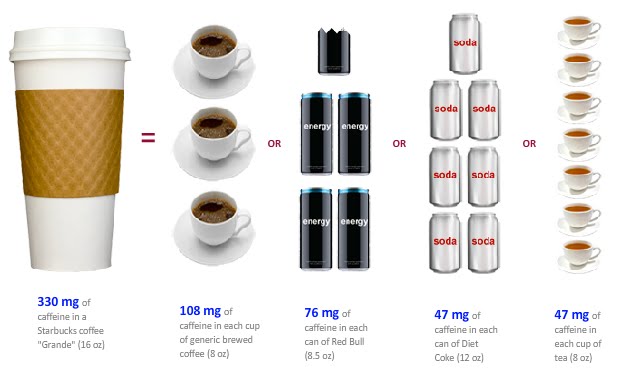
Harvard’s med school put together a bit of an infographic about the health benefits of caffeine. You should totally start drinking it (though there are downsides).

Ria van Dijk has visited the same shooting gallery almost every year of her life. A shooting gallery that spits out a polaroid of people who successfully hit the target.
Here she is at 16.

She’s 88 and still a dead eye.

From this gallery here.
Dear female readers,
It is rare that I step into the murky world of dating and singleness. I just don’t like the flak that comes the way of married people who dare to raise their heads on the issue. But we were all single once… and I’m a guy, and I have single male friends and single female friends, and I realise this is a murky issue and a real struggle for many people – but the problem is compounded by a bunch of myths and misconceptions that are rarely discussed. This post isn’t for you if you’re the kind of girl just waiting for a guy to man up – and it isn’t a post urging guys to man up. I wrote one of them before somewhere (or two). If you’re a guy bemoaning your singleness and you haven’t asked a girl out – man up. Grow some balls. Take a risk. If you’re a guy who is sick of having your heart mercilessly crushed then you should read this letter to a frustrated single man (from elsewhere). And take heart, most married guys have been there too (I know I have). Lets face it. Girls are complicated.

Ladies,
If a man in your life, an acquaintance or friend, asks you to spend some time in his company you can be almost certain that he is interested in you and that he’s actually asking you out on a date (even if it’s not specified) – that he doesn’t want to be “just friends” – it takes enormous courage to ask a girl to do stuff, because when they say no, after you’ve mustered up whatever nerve you have, it feels like you have been belted in the stomach with a baseball bat. It’s crushing and often leads to periods of deep reflection on the question of “what is wrong with me?”
Guys can’t be just friends with girls they are interested in. The same baseball bat like experience hits over and over again every time you observe other guys getting a yes where you got a no. It’s incredibly unlikely that a guy is asking to spend time with you exclusively because he wants to be your mate. If he asks you to dinner, to a movie, to go for a run, to have coffee, to do anything where it’s just the two of you – and you aren’t related – then he’s interested. In his mind one-on-one time is basically a date, and asking you to spend such time is essentially a case of asking you out. And if you’re not, you should say no straight out. Don’t let him down gently. Don’t string him along looking for an opportunity to ease him into it. Rejection hurts, but the longer you drag it out, the more it hurts. And the crueler it becomes.
The worst situation is to be “the brother I never had” – because then you get all the emotional baggage of a relationship with none of the payoff. Hollywood writers know this. They play on that tension with the poor geeky guy all the time. It’s the tension the TV show Bones is built on. And if it frustrates you watching Bones destroy Booth’s heart over and over again then take that lesson and apply it to your life. It seems girls in Christian circles don’t watch enough of these movies and TV shows. Because they seem to sail into these murky waters in negligent or reckless oblivion. I’m sick of sitting by watching guys hearts get messed with by girls who don’t understand this one, foundational idea, guys, 95% of the time, aren’t really interested in being your “mate” – they’ve got all the mates they need, and they don’t want to pile that list up with people who have rejected them.
Relationships are hard work. Love doesn’t happen overnight. You’re not committing to marrying the first guy you go out with. Give a guy a break. If you enjoy hanging out with him in groups, or in one on one settings, don’t hang out for Mr Right – hang out with the guy Mr Right in Front of You. A bird in the hand and all that proverbial jazz.
Most Christian guys have problems – part of becoming a Christian means you recognise you have failings. The ones who don’t appear to have problems are probably arrogant or harbouring some sort of deep seeded emotional issues anyway, scratch the surface of most guys and they’re probably incredibly insecure when it comes to relationships or entirely too scared of commitment to be worth pursuing (that’s why they’ve dated all of your friends and none of the relationships have lasted). If a guy seems to have it together, can hold down a job, and is passable at conversation then he’s probably a winner. It helps if you find him moderately attractive.
Stop hurting my friends. It’s harder being a guy than you realise and you’re just compounding the singleness problem by making the risk of asking a girl out too great and the dating process too serious. If you’re thinking about marriage on or before the first date you’re probably doing it wrong. You’re making it worse for all of your single friends who are dying to have a guy ask them out because you’re making relationships seem out of the reach of mere mortals. You’re also blurring the lines between friendship and guy/girl relationships so that nobody really knows what’s going on. And I’m sick of trying to pick up the pieces on both sides.
That is all.
This is an incredibly incredible use of long exposure light art photography. None of the light paintings are done in post production.
They are coming. Watch out. I make a resolution to stay in high resolution.
Douglas Coupland coined the named Generation X and wrote some books that I like. He’s put forward forty five theses on the future. That are interesting and thought provoking. Here are some of my favourites.
8) Try to live near a subway entrance
In a world of crazy-expensive oil, it’s the only real estate that will hold its value, if not increase.
9) The suburbs are doomed, especially thoseE.T. , California-style suburbs
This is a no-brainer, but the former homes will make amazing hangouts for gangs, weirdoes and people performing illegal activities. The pretend gates at the entranceways to gated communities will become real, and the charred stubs of previous white-collar homes will serve only to make the still-standing structures creepier and more exotic.
17) You may well burn out on the effort of being an individual
You’ve become a notch in the Internet’s belt. Don’t try to delude yourself that you’re a romantic lone individual. To the new order, you’re just a node. There is no escape.
21) We will still be annoyed by people who pun, but we will be able to show them mercy because punning will be revealed to be some sort of connectopathic glitch: The punner, like someone with Tourette’s, has no medical ability not to pun.
33) People who shun new technologies will be viewed as passive-aggressive control freaks trying to rope people into their world, much like vegetarian teenage girls in the early 1980s
1980: “We can’t go to that restaurant. Karen’s vegetarian and it doesn’t have anything for her.”
2010: “What restaurant are we going to? I don’t know. Karen was supposed to tell me, but she doesn’t have a cell, so I can’t ask her. I’m sick of her crazy control-freak behaviour. Let’s go someplace else and not tell her where.”
35) Stupid people will be in charge, only to be replaced by ever-stupider people. You will live in a world without kings, only princes in whom our faith is shattered
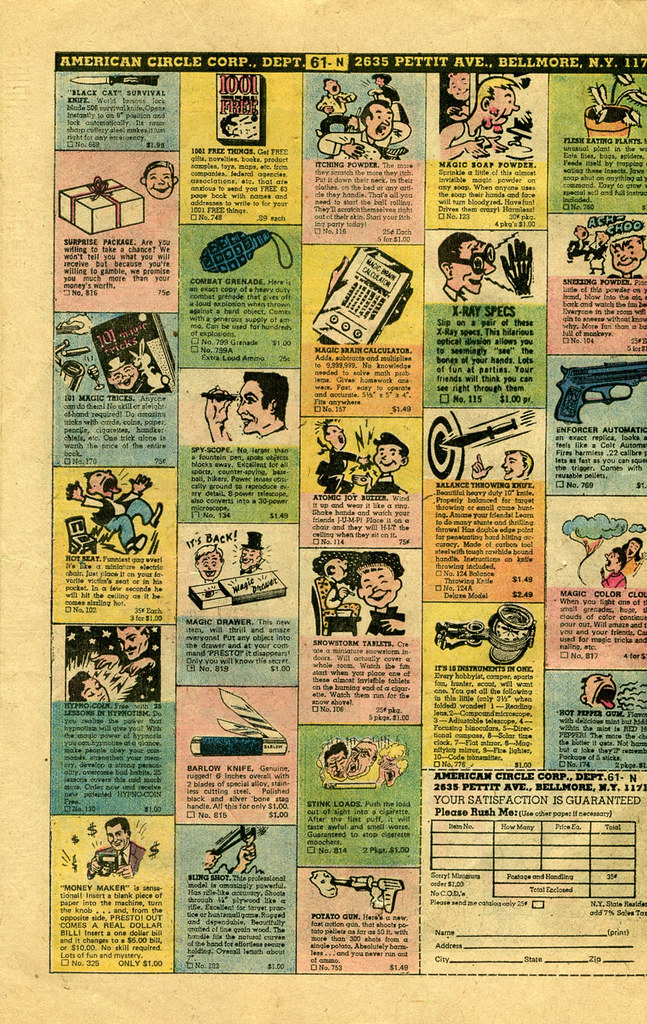
Once (or twice) upon a time I seriously coveted the awesome stuff advertised in the comic book classified ads. Who doesn’t want x-ray glasses? This Flickr collection is fun.
20th century prophets Daphne and Celeste had it wrong when they sang:
“U.G.L.Y
You ain’t got no alibi
You ugly!”
The science of economics proves it.
A new(ish) study published in The Review of Economics shows that ugly people are actually more likely to be criminals. (PDF of the actual study here). Probably because there are only two paths – model citizen and criminal. And they’re not pretty enough…
It’s not a new idea…
The BBC describes the findings as being significant in “the new field of anthropometrics”, suggesting that this could be a handy profiling tool. In fact, anthropometry, in particular detecting criminal tendencies by the measurement of facial characteristics, is a very old discipline. It was previously condemned as pseudoscience – could it be making a comeback?
But they have the numbersTM:
“It is based on an anonymous questionnaire combined with equally anonymous ratings of the subject’s attractiveness. It shows a small but significant correlation between attractiveness, or the lack of it, and criminality. The most unattractive segment are 1.5 per cent more likely to have committed robbery, 2.2 per cent more likely to have committed assault, and 3 per cent more likely to have sold drugs. Or to have been caught doing so, at any rate.
The authors note previous work showing how more attractive people are more successful in their careers and earn more. This puts less attractive people at a disadvantage in the world of work and nudges them towards criminal alternatives.”
Ugliness is also not entirely subjective. Apparently (according to a video essay I made at uni that I have since deleted from memory and existence) it is all about symmetry. Or lack thereof.
If you are feeling unsymmetrical today then you need to kick start your criminal career – there are a few posts about how to rob a bank in these here parts that might help.
Sorry. It’s science.
This is a fascinating feature on the guy who invented the intermittent windscreen wiper and sparked decades of patent lawsuits against major motoring companies. It delves into the murky depths of patent infringement and what does and doesn’t constitute intellectual property in the United States (and globally).
Copyright and Intellectual Property stuff gets really murky. And I think is a product of selfishness. On both the part of the infringer and the producer.
“In the last decade or so, the boundaries of what is patentable have expanded. In 1972, a molecular engineer named Ananda Chakrabarty applied for a patent on a microbe he had engineered that would help break down crude oil. The Patent Office rejected his application, citing a clause in the patent code which says that life forms are not patentable. Chakrabarty appealed, and in 1980 the Supreme Court ruled in his favor, 5-4, creating a brand-new sector of intellectual property: life. Last February, the National Institutes of Health applied for thousands of patents on human genes. The prospect that the United States government may soon own the gene that causes, say, green eyes has naturally created a certain amount of controversy, with some people predicting a kind of land grab at the cellular level–the Japanese patenting brown eyes, Swedes patenting blond hair, Italians patenting Roman noses.”
The story of Ford’s (and plenty of other motor companies’) infringements of Robert Kearns’ windscreen wiper patent is a sad one. He lost his marriage and possibly his sanity in the singleminded pursuit of justice. And what Ford did was wrong.
“Roger Shipman, a Ford supervisor, announced to Kearns that he had “won the wiper competition.” He told Kearns that his wiper would be used on the 1969 Mercury line. Kearns was given the prototype of a windshield-wiper motor to commemorate the occasion. The other engineers welcomed him aboard Ford’s wiper team. Then, according to Kearns, Shipman asked him to show his wiper control to the rest of the team. Wipers were a safety item, Shipman explained, and the law required disclosure of all the engineering before Ford could give Kearns a contract. This sounded reasonable to Kearns, so he explained to the Ford engineers exactly how his intermittent wiper worked.
About five months later, Kearns was dismissed. He was told that Ford did not want his wiper system after all–that the other engineers had designed their own. Kearns remembers that one of the engineers taunted him as he was leaving. “
But that was possibly the result of a systemic flaw in Ford’s thinking – from the founder himself.
“Henry Ford loathed patents. One of Ford’s lawyers once boasted, “There is no power on earth, outside of the Supreme Court, which can make Henry Ford sign a license agreement or pay a royalty.” Ford thought that the patent system should be abolished, because, he said, it “produces parasites, men who are willing to lay back on their oars and do nothing,” and because patents afford “opportunities for little minds, directed by others more cunning, to usurp the gains of genuine inventors–for pettifoggers to gain a strategic advantage over honest men, and, under a smug protest of righteousness, work up a hold-up game in the most approved fashion.””
Inventors are cool though.
“The lawsuit against Ford became Kearns’ life. He put every penny he had into it. He was driven by an uncynical, almost spiritual belief in justice and an equally pure hatred of the automobile industry. At a hearing in 1980, Kearns said, “I want you to understand that I am wearing a little badge here, and that badge says that I am an inventor, and it says I am a net contributor to society. And it is like maybe you can’t see the badge, and these other gentlemen can’t see the badge, and I don’t think anybody is going to be able to see the badge until my trial is finished in this courtroom and I will find out whether I am wearing the badge or not.”