Author: Nathan Campbell

Weekend Project: Ping Pong Cannon
One more for the arsenal of dangerous projects to try at home… And it’s a pretty guaranteed ace in the hole for my next game of table tennis against dad… if it doesn’t wreck the table.

This thing shoots table tennis balls through solid chipboard (oxymoron alert).

From CrunchGear.
Don’t forget your toothbrush
These are some nice ads from Colgate. Nice and sinister.

Colgate normally gives out small product samples at annual events like “Oral Health Month” to remind target consumers, especially kids, to take better care of their teeth after eating sweets. This method does not drive strong results as most consumers tend to forget the message, even if they have collected the samples. Instead of giving away product samples, ice cream and cotton candy were given out. The stick carrying the ice cream and cotton candy carries a hidden message. Once consumers are done the message printed on the tip of the stick shaped like a toothbrush reveals “Don’t Forget” with the Colgate logo. This simple message effectively reminded consumers to brush their teeth.


Flogging a live cow

So far I’ve raised $5 with my really useful gift shop. And I have to confess that I spent that $5 myself. On a fish called Eutychus – or a fish farm full of fish called Eutychus.
I’m not expecting to reach the heights of stuffchristianslike.net – or in fact any heights at all – but I am going to keep the little logo for the shop on the top right of the page. Probably forever. In the hope that one day somebody will buy one of these $300 cows.

Top five rules for blogging: #4 Be prepared to write stupid posts
This is, as the heading indicates, the number four in a series of five posts. Here are all five tips, and here’s my post on the first one, here’s the second one, and here’s the third.
As we discussed in tip number one – nothing kills a blog like a loss of momentum. I think this tip is particularly important in the early stages of a blog.
Blogs aren’t a great medium for people wanting to publish polished essays every time. Some posts are going to be not as good as other posts.
More often than not it’s the posts I think are a bit rubbish that get a spike in traffic or see increased comments.
The best solution I’ve come up with in order to keep my blogging juices flowing is to just post. As often as possible. This means I’ve written some absolute rubbish in my time, which on the whole has contributed to the quality of this blog in a negative manner. But, I’ve also managed to stick at blogging for almost 4 years and almost 2,600 posts.
My post rate, and my traffic, have picked up since I decided to take the “just post any old thing” approach…
I have one or two rules that I use when deciding whether or not to post something. There is a limit to how stupid my posts can be without cheapening the experience of visiting this site.
There’s an important overarching precept guiding my posts – I am a Christian before I am a blogger, and this creates a tension… I want to glorify God with this blog – and I use it as a vehicle for articulating my thoughts on what I’m learning or thinking about Christianity. But I also like posting really silly things. Things that are probably at the pinnacle of human stupidity. And toilet humour. Having two columns has helped me come to grips with this tension – it probably doesn’t help feed readers.
I am, in this post, dealing with my tip to be prepared to post stupid stuff, I’m not sure that I see this stupid stuff as a way to do anything but keep momentum going and perhaps entice people here to be amused – I suspect more people come for the stupid stuff than for the thought out stuff.
Here is, for want of a better label, my checklist for posting a stupid post.
- Did it amuse me? – If the answer is yes I’ll probably post it. If the answer is no, I’ll consider whether it may impress, amuse, or inform, anybody else who I know reads my blog.
- Will it amuse other people – this one’s not a deal breaker and comes down to the blogging for comments principle. I like having readers, but I’d probably approach blogging the same way even if I didn’t.
- Is it likely to offend people I care about. I probably won’t post these – or I’ll check first.
- Has it been posted everywhere/watched by millions? It has to be really worthwhile to post if everybody has already seen it – you won’t find any dancing wedding entrances here…
- Am I breaking any laws? This one is pretty important. Don’t post anything illegal.
Ten years in seven minutes
The noughties in seven minutes.
Via Kottke.
A decade ago…
This time ten years ago we were all worried about the millenium bug. Remember that?

In fact, I just did. I’m going to review it. For fun.
The Amazing Joe Hockey Movement
The Amazing Joel Hockey Movement is a Christian Comedy Folk band/singer. I thought he was funny when I was in high school – I confess I haven’t listened to him much since…
The Amazing Joe Hockey Movement is the series of responses around the blogosphere to Joe Hockey’s vaguely stupid defence of the notion of Christianity in a speech to the Sydney Institute that was published in extract form in the Sydney Morning Herald the other day. It’s received a fair bit of press coverage. With speculation that he was using this speech to round out his character in order to one day make a leadership push.
The backbone of this speech is the idea that somehow the best place to learn about God is not the church – who take things all too literally – but the vibe. It’s mabo. It’s the serenity. It’s stupid.
The notion that somehow Jesus would be unhappy with the idea of people taking the Bible seriously – which he seemed to do throughout his life – is preposterous. It comes from some sort of social superiority complex that for some reason believes that we’re much more enlightened than those who came before us, and that we can stand in judgment on thousands of years of backwards thinking.
I read an annoyingly superior piece along this vein in Sam De Brito’s new “Building a Better Bloke” group blog. Apparently the idea that Jesus “wasn’t a Christian” should be profound. Newsflash. Jesus was the archetypal “people of God” – Christianity is just the way that concept has been branded since we follow him. That’s a dumb proposition, and it just gets dumber.
Apparently Jesus was not about restoring our relationship with God – you know, the “repent, the kingdom of God is near” stuff… no, he was about:
“These are the real issues Jesus was interested in: POWER, PRESTIGE and POSSESSIONS. He hits them again and again.”
I bring this up mainly because a commenter calling himself “the thinker” made this interesting point in the comments…
“In the same way it is the philosophies we as a culture evolve” – I have to pull you up on this one and refer you to scientific anthropology. This is a common mistake which we humans who accept evolution make all the time. We erroneously assume that culture within human society evolves in a forward manner, the same way as genetic evolution did.
Anthropologically, the scientific evidence is that human culture rises and falls more like a flat sine wave. When American culture crashes it can fall to the same depth as Roman culture when it crashed (or even further). There is NO cultural ’safety net’ for a modern culture which will prevent it falling past a specific level cultural level attained in the past. Also, remember that on a genetic scale we are no smarter as humans than the Greeks, the Romans, the Persians, the Mongols, the Huns etc as evolution takes longer than 2,000 years to significantly improve human brain power.
I thought that was interesting.
Anyway, back to Hockey. While suggesting that Christianity should be all about style – without worrying about substance – he made this odd statement about politics.
“The trend I see in politics is one where personality is winning over the substance that should be at the heart of political life.”
Somewhat contradictory methinks.
For a more astute takedown of Hockey’s statement read this response from Phillip Jensen. Or the letters to the editor that came in in response, or Gordo’s response to those letters. Here’s a snapshot from Phillip Jensen…
But Mr Hockey’s expression of values, with or without belief in any particular god, scarcely defends faith in the death and resurrection of Jesus – the man who is God. Christianity, void of Jesus’ divinity or sin bearing crucifixion – is hardly Christianity. Such a statement is not extremist literalism. The cross, not the golden rule, is at the very centre of Christianity. All religions do not teach the same truth when the death of Jesus is central to Christianity and denied by the Koran.
He noticed that the Opera House is usually playing music inspired by faith. But his kind of faith did not and will not inspire such music. He noticed that members of religious organisations are nearly twice as likely to be community volunteers. But his faith has not and will not lead to more community volunteers. He noticed the decline in religious observance in Australia. But he fails to notice that it is those who take their scriptures seriously that are retaining adherents and growing.
On for young and old
I subscribe to Dinosaur Comics. I read them most days. I find them vaguely amusing about 60% of the time and laugh out loud amusing about 2% of the time.
Today’s comic, and the associated diatribe about the way old people handle stories about young people and technology made me laugh. The story it’s responding to is this one about a young guy who used an updated Facebook status as an alibi. You can’t get that from the comic…
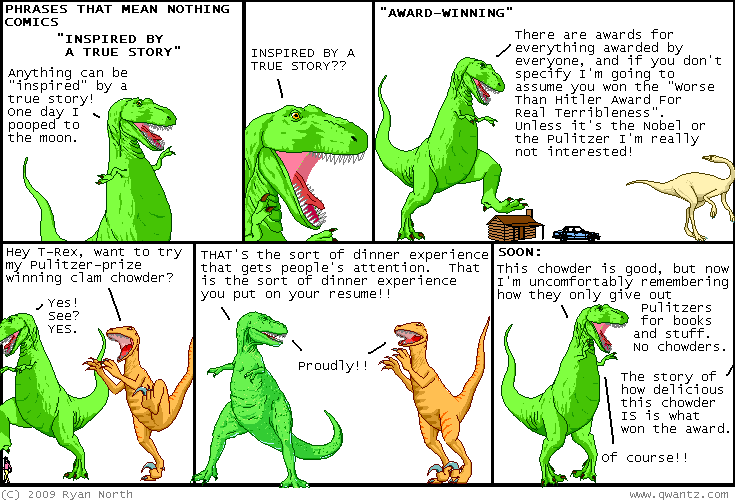
But the associated editorial spells it all out…
But as that article goes on, it slides deep into “oh man OLD PEOPLE STEREOTYPES” territory. Joseph Pollini, who otherwise sounds awesome because he lists “hostage negotiation” as his primary area of expertise, says that teenage HACKERS could have posted that pancake-centric Facebook update to Rodney’s profile while posing as Rodney at his home computer, while Rodney was actually out busy robbing at the time – which, you know, is possible? But it’s not very likely, and it takes some knowledge. No problem, says Joseph! Teenagers are really good at internet, because “they use it all the time”. “They [teenagers!] could develop an alibi. They watch television, the movies, there is a multitude of reasons why someone of that age would have the knowledge to do a crime like that.”
ABC Radio up here in Townsville has an amusing weekly segment with a local lady in her twilight year (how do you say “old” in a politically correct manner?). Last night she was talking about kids and their fat thumbs that come from an insatiable desire to play the latest greatest games.
I think future children are going to be playing the games their fathers give them. The old old generation miss the point that the new old generation embrace technology the same way the new new generation do. Though I suppose there’s a difference between the way even my youngest sister approaches technology and the way I do.
Mark Driscoll, when he was in Australia, made a comment about faith – one generation wholly owns it, the next accepts (or assumes) it, and the next denies it. I think technology works in reverse.
Let us, for a moment, take a look at my family as a case study…
My dad was a classic early adopter. He was an electrical engineer which put him at the front of the curve when it came to developing computer technology. So far at the front of the curve that he wrote a book about one of the first computers. This, through a variety of circumstances detailed in that link, led to a lifetime of early adopting. His generation (and to be kind, the one before it) built the computer industry.
This in turn meant that I grew up experiencing a heap of new computer products and games. I think I wrote my first assignment using the Internet (CompuServe) in 1994. It was about Rwanda. It was, on reflection, possibly the best assignment I ever wrote (except maybe for the self help guide to writing self help books). I like technology. I use technology. I find technology incredibly useful. I think, though this hasn’t really been tested, I could function without it.
My generation benefited greatly from the work of the generation previously – and many of us (not me) are now internet millionaires and billionaires because we missed the first dot com boom and caught the second. We are also a generation of hackers and pirates who believe technology should work for us, not us for it.
Meanwhile the next generation down couldn’t really live without it. Lets take little sister number three as an example. I suspect if I stole her mobile phones (that’s right, plural) she’d go into meltdown. She can correct me if I’m wrong.
Her generation have grown up immersed in technology – some of them have one mobile phone with a bunch of different SIM cards based on who they want to call on free deals. They have adopted a new, and very stupid language where words substitute numbers for letters and acronyms and initialisms flourish.
I’m friends with some of her friends on Facebook. And they’re all like “OMG, OMG!!! I’d totally die without my phone? I totes* need to update my Facebook Status with every meaningless thought” and “where’s my pancakes?”… though that’s sans punctuation including apostrophes. Because they don’t know how to use them.
Her generation, well, they write viruses that carry popular internet pranks onto the phone handsets of many of my generation’s geeks. Those people running around with unlocked iPhones.
I don’t know if there’s a point to this diatribe. Except perhaps to highlight how silly it sounds when any generation talks about the next generation without completely understanding where they’re coming from. People older than me didn’t grow up with computers – though they design the computers and the software that I like to play with… To bring in another topic altogether, this is like music. Young people think anyone about ten years older than them must be out of touch with their music and what’s cool – and yet they’re all listening (with the exception of Jonas Brothers fans) to music made by people ten years older than them.
I think it’s sad when people my age are excited by the prospect of seeing Britney Spears (who’s two years older than me) in concert. Don’t they realise she’s just a vacuous example of our generation? Why aren’t they listening to Radiohead or someone respectable.
The other area this whole generation gap expresses itself in is fashion. I want to know if I’m going to suddenly start dressing like an old person – or if what I wear now, or what others of my generation wear now, will suddenly become old person clothing at some point. I can’t wait for vintage vintage T-Shirts to be the clothing of choice for vintage people. As someone who grew up wanting to find grandpa shirts in op-shops I sense some sort of irony in people buying the t-shirts I wear now in op-shops in twenty years. All in a bid to be cool and authentic.
That is all.
*Totes is an actual quote from several of the next generation’s statuses. It’s a dumb word. It means totally. This is the generation gap at work people.
Build your own breakfast

My love for breakfast cereal knows no bounds. At least not when it comes to being pigeon holed into a time of day.
So I am excited by this site – which unfortunately appears to be a US only kind of deal.
If you can’t read the ingredients on the label of this bag click the image for a bigger version.

We need an Australian version of this. Soon.
Peak Rock
There seems to be a strange correlation between oil production in the United States and the production of good music (as qualified by Rolling Stone magazine).
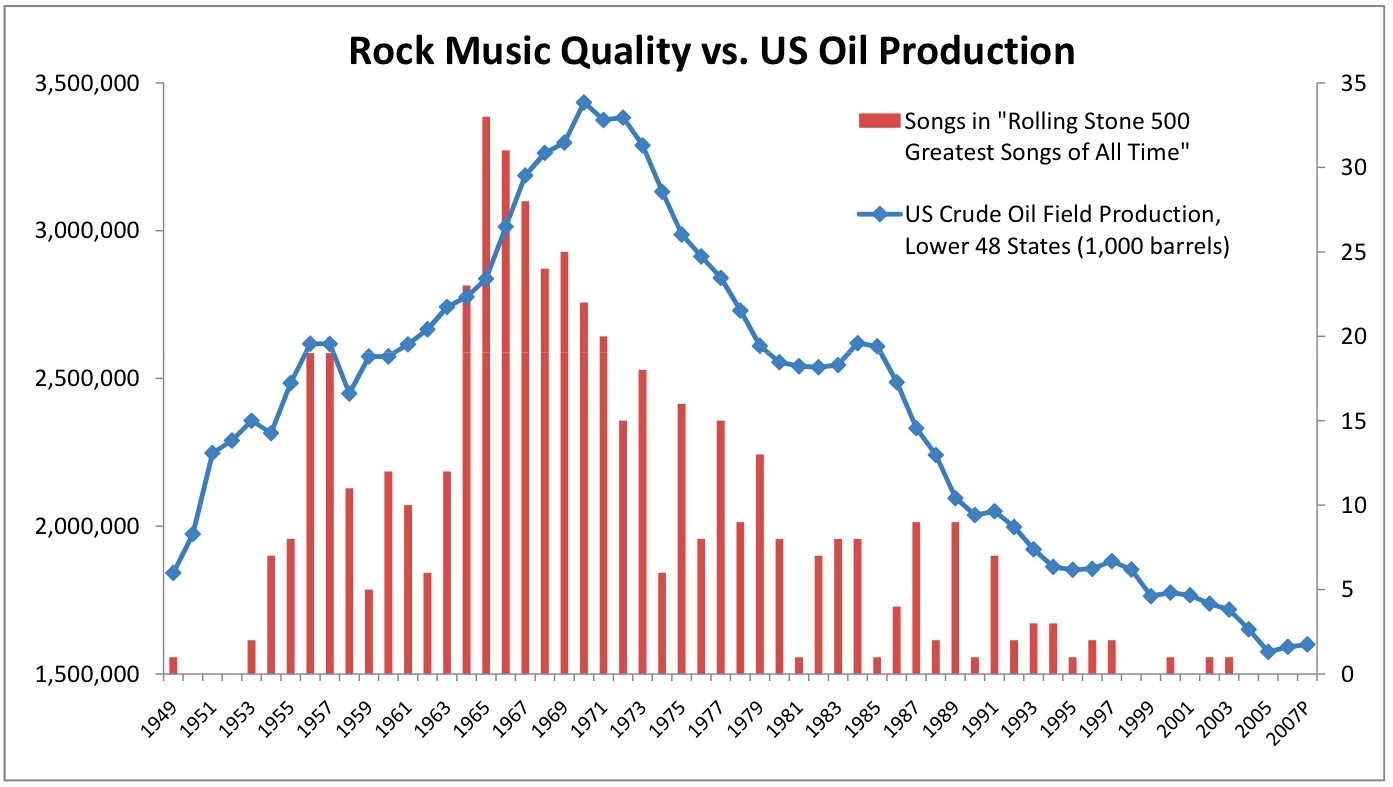
“First, a little theory. The decline in U.S. oil production* is explained by the Hubbert Peak Theory, which states that “the amount of oil under the ground in any region is finite, therefore the rate of discovery which initially increases quickly must reach a maximum and decline.” Makes sense, right? The same theory can apply to anything of a finite quantity that is discovered and quickly exploited with maximum effort.
Including, it would seem, rock & roll. I know, the RS 500 list is not without its faults, but it does allow for some attempt at quantifying a highly subjective and controversial topic and for plotting the number of “greatest songs” over time. Notice that after the birth of rock & roll in the 1950’s, the production of “great songs” peaked in the 60’s, remained strong in the 70’s, but drastically fell in the subsequent decades. It would seem that, like oil, the supply of great musical ideas is finite. By the end of the 70’s, The Beatles, Led Zeppelin, Black Sabbath, the Motown greats, and other genre innovators quickly extracted the best their respective genres** had to offer, leaving little supply for future musicians.”
Via Good.
More than one way to scan a cat…
This electron microscopic scanner is really impressive.

More impressive is the fact that the company selling them will scan and upload any sample you send them. Apparently.


Mmm. Cheese.


The sweet taste of the reformation
I would like some of this John Calvin beer. What a way to cap off a year celebrating the reformation… it’s predestined to be good.
Via David Ould.