These aren’t real (well, nobody sells them), but if they were they’d be deadly and awesome.

Found here.
These aren’t real (well, nobody sells them), but if they were they’d be deadly and awesome.
Found here.
The Jesus All About Life campaign is on in earnest – though it’s unlikely it’ll get much attention as far north as Townsville. Steve Kryger from Communicate Jesus had some insightful critiques of the campaign’s methodology. He copped a bit of flack for daring to stick his head up and say what anybody who thinks a bit about marketing (or works in the field) was already thinking.
My problem isn’t so much with the style of the campaign – I’ve got a problem with the substance.
I think we’re creating a generation of apathetic nominal Christians whose only knowledge of the Bible is John 3:16, and whose only knowledge of God is that he is loving. And all they have to do is “believe”.
I believe in lots of things that I don’t really care about, and if I use that understanding of the word and apply it to God, without reading the rest of the Bible then I can comfortably, and apathetically, rest assured that God and me are mates. And God is loving. So he’ll do right by me…
I don’t think there are many people stopping to think about what this loving God wants them to do with him past belief. And I don’t think “thank you Jesus for birds that look like they’re wearing pants” is the way to move people past that nominal point and into active Christian “belief” – that where thought is outworked, and where Jesus’ righteous place as Lord of our lives is realised.
Yes, God is loving. Yes, we do need to believe in him (as he actually is, not just that he is). But we need to move past that in our marketing campaigns – every marketing campaign needs a call to action. The call shouldn’t be “be thankful for…(whatever makes a nice postcard)” it should be something that enhances the understanding of what it means to be a Christian.
In our marketing at work part of what we’re aiming to do is “sell the sizzle, not the sausage” – which is what you do in a crowded marketplace like tourism where every customer already knows they’re looking for a holiday but haven’t necessarily chosen where. You can’t do this with Christianity. People need to better understand what goes in our sausage before we even try selling it.
UPDATE: Steve Kryger has posted some research that led the campaign in the direction it went in. It makes for interesting reading – basically the people behind the campaign found that people have negative thoughts about Christianity (particularly secular humanists) and they wanted to move away from “traditional” advertising…
“At a more fundamental level, non-Christians tend to reject the idea of ‘one truth’ as a divisive concept that is to blame for much of the conflict in the world today, and that clashes with the secular humanist ideal of taking personal responsibility for lifestyle choices and interpersonal values.”
I don’t get it. The gospel is no good because we can’t sell it?
I maintain my hypothesis that the gospel is less effective because we’ve spent so long selling it so badly. And pulling out the important bits in a bid to not be offensive (I guess reacting against the “turn or burn” fire and brimstone preachers of the previous generation) doesn’t seem to be a greatly effective strategy.
Never let it be said that any content is beneath me…
Everybody needs prank poo in a can right? This must be the biggest untapped market ever. And now it’s filled. You can buy it here. It’s even scented.

I don’t think this is going to be featured on Cool Tools any time soon.
Everyone loves a good burger. For the record you can buy the best hamburger in Townsville at the Cactus Jack’s Saloon Bar on Flinders Street. BP Cluden’s burgers are good. But they pale in comparison to the Cactus burger. Which pales in comparison to this world record winning effort (from this is why you’re fat).
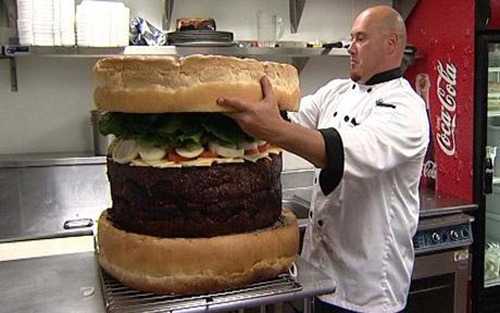
That’s a Guinness World Record Book winner.
In honour of that effort here’s a burger bed you can’t buy…

And a burger cushion set that you can…

Oh, The Temptation from Steve V on Vimeo.
When I have children this is going to be part of the daily dining ritual. This is an apparently famous little social experiment. The kids get two marshmallows if they can not eat the first one for a few minutes.
I reckon the game would be more fun if you didn’t let the kid have the first marshmallow after they waited. That would be a life lesson.
I also want to teach my children that red is blue – like one of my friends did to her little brother (I can’t remember the colours she used).
Apple launched some good stuff this week. Like iTunes 9. And new iPods, with cameras. But don’t let me tell you how good they are. Let them – at their launch…
Someone needs a speechwriter…
I normally call my shirt posts “shirt of the day” – but this one is exceptional. A shirt with a built in Lego base plate. It’s the ultimate in customisability.

Available from ThinkGeek.
This is the funniest Kanye joke yet…

Here’s another one… knock knock
Who’s there?
Interrupting Kanye
Interupting Ka…
Yo, doorman, I know you have to welcome me, and I’m going to let you finish, but Beyonce told the best knock knock joke of all time…
I made that one myself. Can you tell?
Speaking of which, I’m always on the look out for knock knock jokes – tell me your favourites in the comments.
I love satire. Of most colours. I like it when Christians satirise our own culture, and when non-Christians do it too. Satire is revealing. It is good for teaching. It makes me laugh.
LarkNews is one of my favourite satire sites, I know of a few people who have fallen for its satire in the past…
People reposting satire as real news is pretty funny – like when a couple of mainstream news outlets picked up an Onion piece that reported the moon landing was fake.
Poe’s Law didn’t make the Wikipedia list of eponymous laws I mentioned previously – but you can read it on this page – RationalWiki’s page.
Without a winking smiley or other blatant display of humor, it is impossible to create a parody of Fundamentalism that SOMEONE won’t mistake for the real thing.
It’s one of those Internet subculture things particular to debates with atheists (along with the No True Scotsman Fallacy) that comes up all the time. It’s a shorthand thing that prevents any real discussion taking place springing from an extreme position. The problem is that sometimes extreme positions may be correct. This is my biggest problem with all the conversational threads I’ve read on the atheist blogs I follow. If it turns out that God exists (as I believe he does) they’re going to look like idiots. This is the problem with Occam’s Razor, and in fact any other eponymous law that becomes common parlance. There are times when there’ll be a complex explanation for something that is true while a more simple explanation with less steps may be wrong. There are times when it’s appropriate to reference Hitler in an argument (Godwin’s Law). There are times when someone will be claiming to be a Scotsman when they’re not (the No True Scotsman Fallacy).
Using these laws in conversations who don’t know about them makes you look like a prat. Especially if you end up quoting them and being wrong.
I’m going to posit my own eponymous law – and I’d like it to catch on. Campbell’s Law. It states:
“As the length of argument on the internet increases the probability of referencing an irrelevant eponymous law or incorrectly identifying a fallacy approaches one.”
I’ll posit a second law.
“Just because someone, somewhere, has described a common phenomena as a “law”, it does not necessarily render the practice a transgression.”
I’ve wondered what it is that makes Macs cool. I think it might be that they’re powered by guinea pigs.
 I’m not sure how they fit them into the laptops…
I like books. I like old books. I like book titles. You can judge a book by its cover. Normally.
Kottke linked to this great little discussion thread featuring old books retitled for today’s market.
It started off with these – and got more fun in the comments:
“Then: The Wealth of Nations
Now: Invisible Hands: The Mysterious Market Forces That Control Our Lives and How to Profit from ThemThen: Walden
Now: Camping with Myself: Two Years in American TuscanyThen: The Theory of the Leisure Class
Now: Buying Out Loud: The Unbelievable Truth About What We Consume and What It Says About UsThen: The Gospel of Matthew
Now: 40 Days and a Mule: How One Man Quit His Job and Became the BossThen: The Prince
Now: The Prince (Foreword by Oprah Winfrey)”
I haven’t watched this yet – but I read the transcript posted on the Friendly Atheist.
Frank Schaeffer is a little bit angry at some of the good parts of “fundamentalism” – and yes, there are good parts of seeing something as objective truth and fighting for it. He is a former “fundamentalist” and the son of Francis Schaeffer.
But when there’s a relatively large population of your country who are using the Bible to justify the belief that their president is the anti-Christ, while ignoring the other things the Bible has to say about governments (eg Romans 13), and the anti-Christ (1 John 2), someone needs to call it for what it is. Stupid shenanigans. And that’s what Schaeffer does.
“The mainstream not just media but culture doesn’t sufficiently take stock of the fact that within our culture we have a sub-culture, which is literally a fifth column of insanity, that is bred from birth through home-school, Christian school, evangelical college, whatever, to reject facts as a matter of faith.”
“Look, a village cannot reorganize village life to suit the village idiot. It’s as simple as that, and we have to understand: we have a village idiot in this country. It’s called fundamentalist Christianity.”
One of the problems I have with the way Christianity is viewed comes from the fact that atheists hold up the relative strawmen of the fundamentalist fringe, and the actions of the nominal Christians without actually engaging with what Christianity (through the Bible) teaches.
Nice spam
Some commenters around the interwebs should take a note out of this spammer’s book…
Thanks Bill Bartman. I appreciate your candor and kindness.
September 18, 2009