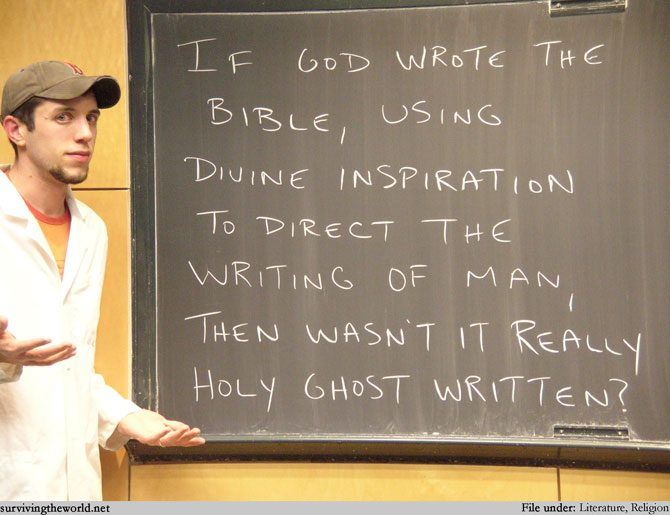
Here’s a joke I’m going to pull out next time a conversation about divine inspiration of Scripture comes up at college.

Here’s a joke I’m going to pull out next time a conversation about divine inspiration of Scripture comes up at college.

Long time readers will remember the world’s worst “worship”… purely assessed from an aesthetic standpoint – I don’t know if this is acceptable to God. That’s up to him.
Here are two contenders to knock it off its throne (I have included the original as the third video in this post). In the Hokey Pokey one it’s worth persevering until 3.48. Apparently short term memory is not biblical… nor is Alzheimer’s.
You know. Jesus was pretty darn awesome and he hung out with all the movers and shakers in first century Jewish society – so we should totally do the same with our ministries… no wait. That’s not right. An Acts 29 church planting screener has pointed out that a number (all is a number) of the planting candidates he’s interviewed have the same missional passion – the desire to see cool people saved.
It’s amazing how many young pastors feel that they are distinctly called to reach the upwardly-mobile, young, culture-shaping professionals and artists. Can we just be honest? Young, upper-middle-class urban professionals have become the new “Saddleback Sam”.
Seriously, this is literally the only group I see proposals for. I have yet to assess a church planter who wants to move to a declining, smaller city and reach out to blue collar factory workers, mechanics, or construction crews. Not one with an evangelsitic strategy to go after the 50-something administrative assistant who’s been working at the same low-paying insurance firm for three decades now.
His conclusion is just as on the money.
It could be that we’re simply following in the footsteps of the church growth movement that we’ve loved to publically criticize while privately trying to emulate – we’ve just replaced Bill Hybels and Rick Warren with Tim Keller and Mark Driscoll.
In the Australian context it’s probably not so bad – but it’s just something to remember. Jesus loves city people, young professionals, farmers, retirees and the homeless. Our ministries should love those people too.
* Check out the King Missile song by this name if you haven’t already discovered it.
Can we ever choose our own destination or are we just pawns in a grand game of chess at the hands of an omnipotent deity. Are your choices your choice? Or are they the inevitable product of nurture and nature colliding. It’s a question that literally keeps young theologians and philosophers up at night.
I’m not actually sure where this originally came from – it just popped up in deli.ci.ous. But it made me laugh.

I went along to see Richard Dawkins in Brisbane tonight. The results were unsurprising. I agreed with most of what he had to say – everything except his starting assumptions and conclusions.
He started by telling us all that our lives are incredibly improbable. That we should never take them for granted, that we should never take our existence for granted, and that we should marvel at our very unlikelihood. Then, he suggested, as his latest book indicates – evolution is the greatest and only show on earth.
Our improbable beginnings began with an improbable meeting of improbable matter that expanded improbably in a way that created stars and then life and then us. Somehow it makes more sense to believe a void created complexity than to believe a God did. But we can’t believe that a void created a God (especially the God of the Bible) who would eventually create a world… Once you start speculating about origins all the options seem possible to me.
It is, of course, improbable that anything like a God could possibly have been involved in the process – because for Dawkins as soon as you can describe the process the notion of an author is redundant. He ridiculed the God of the gaps (which is ridicule worthy) and a bunch of other strawmen. Then he closed with a question and answer session.
He was funny, engaging and most concilliatory. He just isn’t really engaging with any Christian belief that includes the ability to synchronise Christian belief with scientific truths, and he doesn’t seem to think that the Christian lay person is capable of anything but a strict, fundamentalist interpretation of particular passages. He did, in question time, suggest that the enlightened “bishops and archbishops” of the Christian world believe that God may have had some role to play in the start of everything but has then stepped back. Curiously missing the point of the incarnation.
He had a swing at anyone who believes anything on the basis of faith, authority, or feeling (there was one other factor – I forget) – and suggested that evidence is where it’s at. Which is fine. But he doesn’t really have anything to say to those of us who are believers because we think the evidence for the death and resurrection of Jesus is compelling. Like a modern day Don Quixote he spends most of his time tilting at windmills to the cheers of an equally delusional crowd. Until he starts actually engaging with the facts his efforts to discredit his opponents are risible.
I think in the process of answering questions from the floor (particularly one about whether our close relationship to the ape world had any moral implications) he may have suggested it was morally ok to breed with the entities that link us biologically to the apes – the only problem is that they’re extinct.
In question time a couple of people asked about the evolutionary future of humanity – I still want to know how feasible my shirt is – will we one day turn into shape shifting alien robots? Or self healing immortal mutants with retractable claws? I sure hope so.
Gary’s tips on application
Our challenge is to preach and teach for people’s good and God’s glory.
Questions to ask when applying:
Looking at Titus 2.
You must teach what is in accord with sound doctrine.
False teaching wrecks people’s lives.
“You and I look at things very differently. For you things are black and white. For me there are shades of grey.” – a former minister to Gary.
Like what? Like the divinity of Jesus and every other core truth of Christianity.
Paul’s main concern is not for doctrinal orthodoxy (everyone teaching the same thing) but for the application of doctrine through preaching. The nuts and bolts of Christian living.
He doesn’t say make sure your doctrine is sound – but make sure you speak in accordance with sound doctrine.
It’s not a question of Titus’ doctrine but a question of his preaching. Speak in a way that fits with sound doctrine – his concern is with the damage caused by false teachers rather than what they are teaching.
2v1 introduces the subject of teaching that doesn’t damage but gives health. Calvin says “teaching that can build men up in Godliness.
Paul is saying “we need to learn to teach the Bible wherever we are in a way that promotes spiritual help.”
Calvin says “if we leave it up to men to decide which teaching to adhere to they will never move one foot.”
No other passages that spell out the responsibility of preaching like this one here.
Impactful teaching is almost always preaching – sometimes the preachers have broken every rule in the book and have bad models – but the common thread is the powerful application of the gospel.
Some further bits of wisdom
You can’t preach the Old Testament faithfully while avoiding the subject of God’s judgment. Especially in the current age where the idea that the God of the Old Testament is “evil”.
Bonus Bit – David chopping Goliath’s head off is an echo of, and an allusion to the story of the Philistines capturing the ark and it causing their idol to fall over until its head falls off.
Apparent injustice may in fact be a case of not knowing all the facts.
To make sense of the cross we need to understand that God is:
The God of the Cross is breathtakingly holy, passionately commited…
Without the OT – and in particular these stories of judgment – we can not have any idea how holy God is, or the depths to which people sink, or how important it is for the God of the Bible to deal with sin in a way that is fitting. We can not hope to understand the cross without it.
If we ditch the nasty bits we are ditching the holiness and justice of God. These stories are there to teach us that God is not tame – that he does things that shock us.
It is not our job to apologise for God’s behaviour.
God’s actions are explained in Romans 3.
19Now we know that whatever the law says, it says to those who are under the law, so that every mouth may be silenced and the whole world held accountable to God. 20Therefore no one will be declared righteous in his sight by observing the law; rather, through the law we become conscious of sin.
21But now a righteousness from God, apart from law, has been made known, to which the Law and the Prophets testify. 22This righteousness from God comes through faith in Jesus Christ to all who believe. There is no difference, 23for all have sinned and fall short of the glory of God, 24and are justified freely by his grace through the redemption that came by Christ Jesus. 25God presented him as a sacrifice of atonement, through faith in his blood. He did this to demonstrate his justice, because in his forbearance he had left the sins committed beforehand unpunished— 26he did it to demonstrate his justice at the present time, so as to be just and the one who justifies those who have faith in Jesus.
Bizarrely, we culturally think that our treatment of the planet reaps just rewards – seeing causation in our actions – and occasionally predicting our own painful demise – but we will not afford God the same courtesy. Gary referenced the Day of the Triffids and this post from an Irish friend.
In the two episodes (which were rather a drag unfortunately), we got lots of warnings about what happens when you interfere with nature, namely that nature will eventually inflict its wrath on you. Come to think of it, this was a sort of Wrath of God story with nature standing in for God.
In fact in the last few years there have been several ‘Wrath of Nature’ movies; The Day the Earth Stood Still and The Day After Tomorrow to name but two. In both movies, and in this latest version of The Day of the Triffids, we are led to believe that we deserve what’s coming to us.
The funny thing is, no-one would ever make a movie these days about the Wrath of God in which the message also was that we had it coming to us. We’re able to accept that if we sin against nature we deserve our punishment, but not if we sin against nature’s maker.
Reading back on my post about Gary Millar’s tips for preaching the Old Testament I realised I’d missed a couple of pages of notes. Here are some more nuggets of wisdom from the mouth of the Irishman…
“Don’t you know young man that from every town, and every village, and every little hamlet in England, wherever it may be, there is a road to London?” “Yes,” said the young man. “Ah!” said the old divine “and so form every text in Scripture, there is a road to the metropolis of the Scriptures, that is Christ. And my dear brother, your business in when you get to a text, to say, ‘Now what is the road to Christ?’ and then preach a sermon, running along the road towards the great metropolis—Christ. And,” said he, “I have never yet found a text that had not got a road to Christ in it, and if I ever do find one that has not a road to Christ in it, I will make one; I will go over hedge and ditch but I would get at my Master, for the sermon cannot do any good unless there is a savour of Christ in it.”
Last night Gary Millar spoke on Song of So(ngs)lomon. With a particular focus on how to preach it. He had what I think is a pretty interesting take on the book – an interpretation that would make Song of Songs a nice foil to Ecclesiastes (which explores the futility of a life lived pursuing material happiness).
He suggests the book is written by Solomon about “the one that got away” – a woman who rebuffed his advances because she had found true love with her “beloved”. The thrust of the argument is that the book then gives Solomon’s insights into a life lived pursuing happiness and completion through the pursuit of sexual encounters – and comes to the conclusion that true happiness is found in its proper context, and if you fully subscribe to his theory, real satisfaction and joy comes through experiencing the love of God.
Here are my notes in slightly edited form. Simone has blogged her response to the evening here.
Some helpful stuff from one of the planet’s leading authorities on “the most important book of the Bible” (rough paraphrase)…
The structure of the book is grace in the past, grace in the present and grace in the future. It’s the book that holds everything together – the climax of the Pentateuch and the key that unlocks the rest of the OT (historic narratives and the prophets), and the NT. How do we understand the concepts of blessing and curse? How do we understand grace? Well, it’s here in Deuteronomy.
The logic of 2 Ways to Live comes from Deuteronomy 27.
Jesus answers the Devil, during his temptations, from Deuteronomy.
Getting to grips with this book really matters.
We can’t nail the structure down to any “king treaty” from history. Quite clear that this book breathes the air of covenant – and a covenant relationship. It’s pretty clear that whatever else is happening this is Moses’ final sermon on the subject of God’s covenant with Israel.
Stupid Academic Theory which holds “Moses could not have foreseen the exile so it must have been written later by someone pretending to be Moses”.
Counter – If Moses has spent his lifetime dealing with Israel messing things up it’s reasonable to assume that he could credibly predict the behaviour of Israel in the future. The foundation of a lot of studies in academia in the last 60 years is on the idea that it’s a late book. A natural reading of Deuteronomy could lead you rightly to the conclusion that Moses, having lead Israel for forty years of frustration, might be in a position to come to these conclusions on the basis of his experience.
One of the amazing things about the zigzagging wandering through the desert is the accounts of the neighbouring nations – “your brothers the descendants of Esau”… God says “I have given the Edomites their land”… then, “I have given land to the Ammonites as the descendents of Lot”… the descendents of these other people managed to find their place while Israel failed – including dealing with giant peoples who occupied them, which Israel failed to do.
What is a reference to King Og’s bed doing there in the narrative – he’s a giant who Israel vanquished in their history – but they were too scared to take on the giants in the promised land first time around… this is a critique of Israel’s failure to take God at his word – they managed to deal with giants originally, their neighbours managed to deal with them, and yet, when it mattered Israel failed.
Bonus insight – In Hebrew “to hear” is “to obey” – it means to have taken the information on board and responded appropriately…
Several years ago the suggestion emerged that this passage is actually based on the Ten Commandments… which makes sense when you look at the structure. What you find if you look at chapters 12-26 is that you can find some parallels with the structure of the Ten Commandments.
When it gets to commandments 6-10 it gets very messy – but perhaps by the time they get to commandment six Moses has made his point and doesn’t need to maintain the structure.
When God makes a covenant he makes it with every generation of his people. While God made the promises to a previous generation Moses talks like the promise was made to the current people.
What are we looking at these laws for? We’re not the Israel – we’re 21st century Christians. As soon as we get to the laws all sorts of warning bells go off that this must be legalism. How do you get these chapters across?
Israel, as a society was to be a living breathing model about what life under God was about.
What is it about these laws that would make the surrounding neighbours gasp? There will be principles and pictures of what it means to be the covenant beauty of God.
The OT does not, and never did, understand under a works/righteousness system. The required response to God’s grace was the same pre Christ (though manifested slightly differently).
“Do not cook a young goat in its mother’s milk”
Did anybody ever think this was a good idea? It seems a bit random.
“When men fight with one another and the wife of the one draws near to rescue her husband from the hand of him who is beating him and puts out her hand and seizes him by the private parts then you shall cut off her hand. Your eye shall have no pity.”
Was this some sort of joke Moses inserted to make sure people were paying attention – there appears to be no historic enforcing of this law.
Calvin’s division of law into ceremonial, civil, and moral doesn’t actually fit with the text.
A better division:
The ultimate inheritance of Israel is not the land – it’s the God of the land.
A lot of the book is to do with human relationships.
Apologies – these are rough notes – Kutz is also liveblogging…
A couple of questions I ask myself as I teach parts of the Bible.
Gary Millar is an Irish OT scholar who is Yoder smart. I’ve been wanting to use that pun since listening to Mark Driscoll.
He’s at QTC today speaking on how to preach the Old Testament. He’s got seven basic ways to bring an Old Testament passage to Jesus. These are the points with some notes.
1. Follow the plan – Genesis to 2 Kings is a narrative that leaves us waiting for the ultimate king – wherever you are you can say “this is the first bit of the plan which will ultimately lead to Jesus”
2. Expose the problem – sometimes the Bible just shows up that left to our selves we do some horrendous things. Some narratives just highlight that we are deeply sinful people.
3. Some parts are there to explain categories – what is Leviticus doing in the Bible? Several things. It explains how sacrifice works – how can we understand sacrificial language in the NT if we don’t understand how it worked in the OT. Leviticus explains the category of “ritual cleanliness” – we can’t leave the house without becoming unclean (like Israel who couldn’t avoid becoming unclean).
4. Highlight the attribute – Some stories are there just to show us what God is like. What’s the book of Hosea there to do? In essence it’s there to show us the love of God to an unfaithful people. If you’re preaching on Hosea you highlight the love of God by being faithful to the text – but at some point you have to interact with the NT and what it has to say.
5. Trace the fulfillment. Micah – the “ruler coming out from Bethlehem” – some passages make it easy, in others it’s harder. Different to “following the plan” which involves following the story, tracing the fulfillment is more direct/specific. God promised to do this, he did this.
6. Focus on the action – David and Goliath – the action is 33 words of 58 verses. The rest is David’s commentary on the action – it’s the Lord fighting his enemies. (extra thinking – David and Goliath is like a boxing match with a huge descriptive build up and a very quick knock out).
7. Point out the consequences – Some parts of the Bible make it very clear that if you live without God this will happen, if you live with God this will happen… how wisdom literature fits into the scheme of Biblical theology.
“I think that boring preaching is sinful and we’ll have to answer to God for it.
Boring preaching makes the pew warmer feel guilty and then bored. They walk out feeling worse than they felt when they walked in.”
When approaching the OT Gary takes the following steps.
He added the following insights…