I saw this watermelon art a couple of days ago – and it’s been floating around waiting to be posted (and possibly haunting me in my dreams since… seriously). There are more of these here. It makes my head hurt.

I saw this watermelon art a couple of days ago – and it’s been floating around waiting to be posted (and possibly haunting me in my dreams since… seriously). There are more of these here. It makes my head hurt.
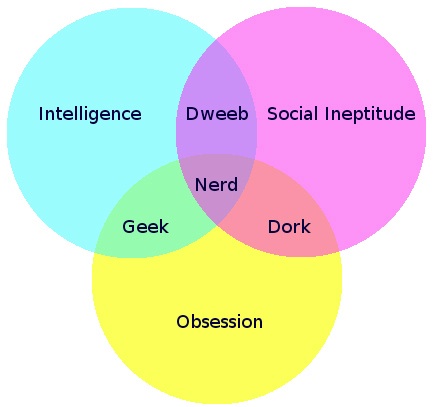
A while back I was trying to figure out the difference between nerds and geeks. My hypothesis is that the terms are not interchangeable. I think the matter is settled once and for all by this Venn Diagram…
I thought long and hard about what my next article was going to be. I have been working somewhat on a series of articles related to children, including should children be subsidised and are current custody laws in the Family Law Act adequate. However, these article take a fair amount of time to do.
However, for me, there were two events last week that really stood out. The first was the release of the latest Sensis Business Index.
On Wednesday the Sensis business index came out, and included one of the findings that, after 21 consecutive quarters of this prestige title, New South Wales was overtaken by Queensland as the least popular Government amongst Small and Medium Enterprises (in terms of their opinions of government policies impacting small business).
Anna Bligh is already struggling in the poles, and you think that this would be a fine source to use to ridicule her. Instead, the Queensland opposition seemed unblissfully unaware of this. Instead, from my limited media exposure, the main topic for journalistic reporting for the day was the Treasurer beating up the opposition over teddy-bears. Further, few media outlets even realised the Sensis report. Queensland Business Review picked it up rather early, but otherwise it mostly went missing.
This compares to earlier in the week, when the most recent Tourism data was released. The big story was Victoria overtook Queensland in Domestic Tourist Visitors. It led to quotes like this:
“The offer of big events, cultural events, retail, food and wine is considered more attractive than stuff like theme parks, Big Pineapples and gee-whizzy type of stuff,” Victorian Tourism Industry Council chief Anthony McIntosh said.
Apparently culture includes the absence of severe storms, floods, an oil spill and all the bad PR stemming from these. But this is beside the point.
Last week highlighted two things, the severe disadvantage the opposition is at due to its lack of human resources, and the absolutely woeful state of Queensland journalism.
I have always hated Today/Tonight. I think it more miseducates the public rather than provides a good consumer watchdog type service. While I think the media has become to an extent the method of exposing and crushing certain elements of society that seemingly fall through other safety nets (e.g. exposing dodgy dealings, etc), I am not sure Today/Tonight deserves much kudos in this regard. I tend to think Today/Tonight more highlights rather unimportant issues, directing attention away from issues that deserve focus and onto things that benefit less from continual oversight. It gives many issues that really don’t deserve much more than a passing comment a place in the limelight, determining the content of talkback radio switchboards the following day. And the ABC isn’t much better. I watched some Tony Jones interviews a while back that were absolutely terrible. He got various politicians on to discuss policy, and Tony Jones’ interviewing technique was all about aggressiveness and trying to get the interviewee to trip up. If a certain issue wasn’t working, he moved on to the next one. Providing an interview that provided information to the public and discussing the actual policy was non-existent. It was all about the spectable.
In a perfect world, the media would be on-top of issues, and be able to disseminate and present it to the public in understandable chunks. While it seems many journalists aspire to report the facts and avoid opinion, it seems that disection, inference and explanation also have disappeared. Instead, they go for the candy issues, the stuff that BTN would present to schoolchildren if all BTN’s employees were dead.
Analysis should be an integral part of journalism. Journalism has become a spoon-fed role. Journalists get given a prepared statement, and they put it through the journalism machine and out pops an article. I think the machine applies quotation marks and a snappy headline. Still, the commercial goals of the media are not in alignment with Australia’s democratic processed. With the media more concerned with the easy stories and the politician cheap-shots or trips-ups, politicians will be more focused on media and perception management rather than governance and providing policy related information.
Without the resources and personnel the government has available, opposition attacks seem to be limited to what they can derive from mainstream media. These days, Australian opposition parties are very limited in the extent of their government oversight roles, and winning an election is more a case of the government losing the support of the populace rather than the opposition winning it.
We have to begin to wonder, given the importance of the media in our political structure, does something need to be done?
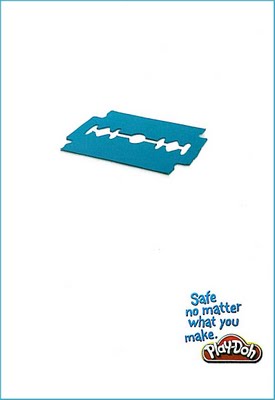
Play Doh is one of those play things that has no doubt suffered because of the sheer awesomeness of modern toys. Have you seen the new Transformers toys?
Play Doh’s marketer obviously has – because this new campaign they launched in Singapore is pretty awesome. And edgy. Here are some of the print ads.

I deal with journalists frequently. They are often a cause of professional frustration. But it can be a tough job. Especially when your screw ups are very public, and live. Like these.
So you’re producing a movie. You want it to win an Oscar. Where should you set it? It’s one of life’s great questions.
A question finally answered by this infographic.

If you were writing a movie about the sugar industry you could set it in North Queensland, in Lucinda, and this title would then make sense.
These aren’t real (well, nobody sells them), but if they were they’d be deadly and awesome.

Found here.
The Jesus All About Life campaign is on in earnest – though it’s unlikely it’ll get much attention as far north as Townsville. Steve Kryger from Communicate Jesus had some insightful critiques of the campaign’s methodology. He copped a bit of flack for daring to stick his head up and say what anybody who thinks a bit about marketing (or works in the field) was already thinking.
My problem isn’t so much with the style of the campaign – I’ve got a problem with the substance.
I think we’re creating a generation of apathetic nominal Christians whose only knowledge of the Bible is John 3:16, and whose only knowledge of God is that he is loving. And all they have to do is “believe”.
I believe in lots of things that I don’t really care about, and if I use that understanding of the word and apply it to God, without reading the rest of the Bible then I can comfortably, and apathetically, rest assured that God and me are mates. And God is loving. So he’ll do right by me…
I don’t think there are many people stopping to think about what this loving God wants them to do with him past belief. And I don’t think “thank you Jesus for birds that look like they’re wearing pants” is the way to move people past that nominal point and into active Christian “belief” – that where thought is outworked, and where Jesus’ righteous place as Lord of our lives is realised.
Yes, God is loving. Yes, we do need to believe in him (as he actually is, not just that he is). But we need to move past that in our marketing campaigns – every marketing campaign needs a call to action. The call shouldn’t be “be thankful for…(whatever makes a nice postcard)” it should be something that enhances the understanding of what it means to be a Christian.
In our marketing at work part of what we’re aiming to do is “sell the sizzle, not the sausage” – which is what you do in a crowded marketplace like tourism where every customer already knows they’re looking for a holiday but haven’t necessarily chosen where. You can’t do this with Christianity. People need to better understand what goes in our sausage before we even try selling it.
UPDATE: Steve Kryger has posted some research that led the campaign in the direction it went in. It makes for interesting reading – basically the people behind the campaign found that people have negative thoughts about Christianity (particularly secular humanists) and they wanted to move away from “traditional” advertising…
“At a more fundamental level, non-Christians tend to reject the idea of ‘one truth’ as a divisive concept that is to blame for much of the conflict in the world today, and that clashes with the secular humanist ideal of taking personal responsibility for lifestyle choices and interpersonal values.”
I don’t get it. The gospel is no good because we can’t sell it?
I maintain my hypothesis that the gospel is less effective because we’ve spent so long selling it so badly. And pulling out the important bits in a bid to not be offensive (I guess reacting against the “turn or burn” fire and brimstone preachers of the previous generation) doesn’t seem to be a greatly effective strategy.
Never let it be said that any content is beneath me…
Everybody needs prank poo in a can right? This must be the biggest untapped market ever. And now it’s filled. You can buy it here. It’s even scented.

I don’t think this is going to be featured on Cool Tools any time soon.
Everyone loves a good burger. For the record you can buy the best hamburger in Townsville at the Cactus Jack’s Saloon Bar on Flinders Street. BP Cluden’s burgers are good. But they pale in comparison to the Cactus burger. Which pales in comparison to this world record winning effort (from this is why you’re fat).
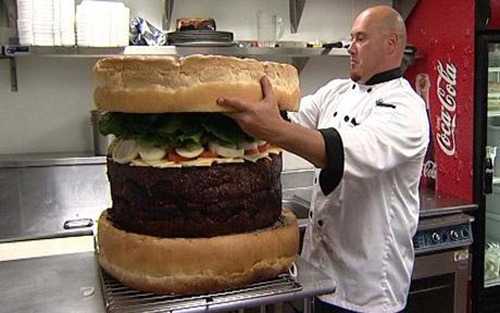
That’s a Guinness World Record Book winner.
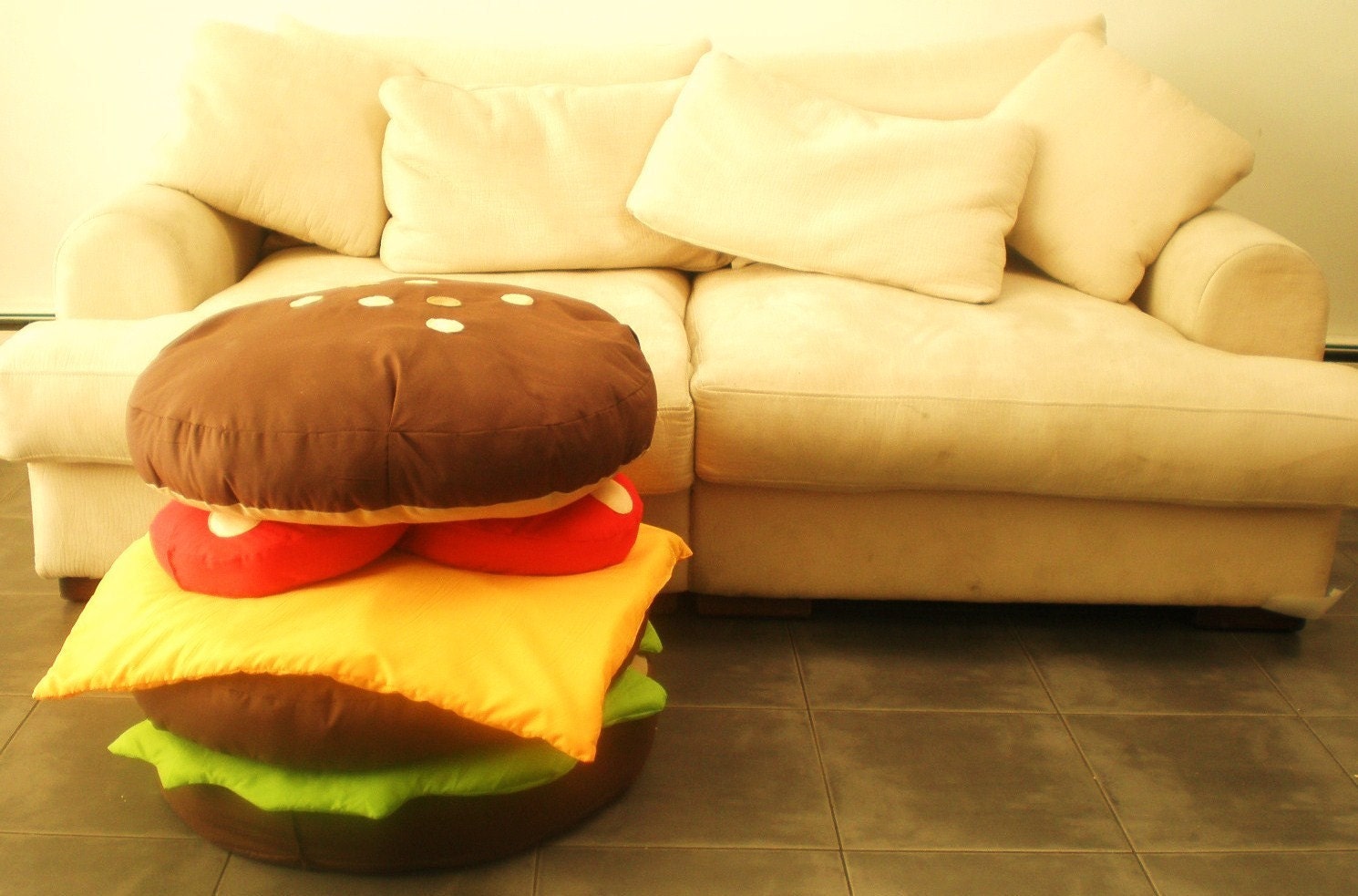
In honour of that effort here’s a burger bed you can’t buy…

And a burger cushion set that you can…
Oh, The Temptation from Steve V on Vimeo.
When I have children this is going to be part of the daily dining ritual. This is an apparently famous little social experiment. The kids get two marshmallows if they can not eat the first one for a few minutes.
I reckon the game would be more fun if you didn’t let the kid have the first marshmallow after they waited. That would be a life lesson.
I also want to teach my children that red is blue – like one of my friends did to her little brother (I can’t remember the colours she used).
Apple launched some good stuff this week. Like iTunes 9. And new iPods, with cameras. But don’t let me tell you how good they are. Let them – at their launch…
Someone needs a speechwriter…
I normally call my shirt posts “shirt of the day” – but this one is exceptional. A shirt with a built in Lego base plate. It’s the ultimate in customisability.

Available from ThinkGeek.
This is the funniest Kanye joke yet…

Here’s another one… knock knock
Who’s there?
Interrupting Kanye
Interupting Ka…
Yo, doorman, I know you have to welcome me, and I’m going to let you finish, but Beyonce told the best knock knock joke of all time…
I made that one myself. Can you tell?
Speaking of which, I’m always on the look out for knock knock jokes – tell me your favourites in the comments.

Nice spam
Some commenters around the interwebs should take a note out of this spammer’s book…
Thanks Bill Bartman. I appreciate your candor and kindness.
September 18, 2009