I like a good Yo-yo show. Long time readers might remember K-Strass the Yo-Yo man. So Yo-yos in space. Well. Cool.
Via Kottke.
I like a good Yo-yo show. Long time readers might remember K-Strass the Yo-Yo man. So Yo-yos in space. Well. Cool.
Via Kottke.
Ok. Another example of internet phenoms combining… Slow mo guys do the cinnamon challenge.
Here’s a couple of other people doing it… language warnings apply…
When Youtube sensations collide…
Union is the inferior rugby code, but this ad explaining it for a potential US audience is pretty special.
I thought I’d posted the first instalment of this last time around – but can’t seem to find it. Anyway. Noah Kalina puts on a one man boys to men – or boy to man – show in this video. It’s very cool.
Waiting at traffic lights is dead time. This little installation art/retro gaming homage is pretty cool…
This week QTC is on mission. We’ve travelled quite a distance. Across one road, and an oval, to the University of Queensland (UQ). QTC is based in a residential college at UQ. We’re helping out with Jesus Week – the on campus mission of student Christian groups Evangelical Students, Student Life, Unichurch, and Uni Impact… you can also check out the Facebook page for details about the week of Jesus based shenanigans.

Today I spoke about Jesus and Judgmentalism – to a room full of people, apparently there were even some visitors, and I met at least one person who reads St. Eutychus, who I’d never met before. That’s always fun.
There’ll be a podcast up soon – but be warned, the audio failed on the real run, and this is me reading it out, pretty much as fast as I could, in a semi-empty room where other people down the other end were talking about other things. So it’s not really representative of what went down – people did laugh at my jokes. They were very kind.
If you’re at UQ – come along to the other talks – especially the ones on Thursday, because I’ll definitely be at both of them, and they’re good… we’ll also be doing stacks talking to people around the campus about who they think Jesus is. So if you’re the praying type – it’d be good to keep this week in your prayers.
I love that the week is all about Jesus – because he really is what counts.
I’ve got just over a kilo of this Tanzanian coffee left (well, only the Clouds of August stuff actually).
But we’ve raised enough to cover a day of Arthur, Tamie, and Elliot’s life in Tanzania. If you want to know more about Tanzania, and Arthur and Tamie’s plans to work with student ministries in Dodoma, Tanzania, then you should check out meetjesusatuni.com.

If you wanted to order some Tanzanian coffee – but haven’t yet – shoot me an email. I’d be happy to order and roast some more if the demand is there.
You’ve probably seen this already. But I owe the internet a series of funny YouTube videos after last week’s type fest.
“When the goat is startled or excited it causes a stiffening of the muscles,” which causes the goat to fall over. Like this
I love this sort of reporting. Journalists going above and beyond to get a unique story, I especially love the sort of “access all areas” (however carefully stage managed by the subject) feature, when the subject is something that happens behind doors that are usually well and truly closed to the public.
This photographer named Anton Kusters embedded himself in the life of a Japanese Yakuza crime family, producing a series of photos for an art exhibition and book. He blogged his way through the project here.
I arrive early. I’ve hitched a ride with two young recruits who will be trained here. I have no idea where we are, other than that we are at the beach somewhere, several hours away from Tokyo. We park the car and head on to the compound.
It’s a regular little seaside town, and the place we’re staying in is a traditional Japanese guest house. We walk up to the late Miyamoto-san, who is in charge of the annual organization, and greet him. He’s going over the daily routine together with Tanaka-sensei.
Tanaka-sensei is a master swordsman and martial arts teacher, who has fought in the Afghan war in the 1980′s by training the Mujahedin in different combat and sword fighting techniques. He is here to teach the recruits meditation techniques, unarmed and armed combat, and bodyguard practice.

There are a couple of images at these links that may or may not be disturbing – so I wouldn’t necessarily recommend buying the book or anything…

I can never figure out why, apart from an overdeveloped sense of their own grandeur or significance, a career criminal, or a criminal organisation, would want the exposure that attention like this brings.

“In the hotel bar I am only slowly starting to understand the minutial social order that is continuously happening within the Yakuza, the micro-expressions on the faces, the gestures, the voices and intonations, the body language. Everything seems to be strictly organized but at the same time seems to come naturally: strangely, I don’t need anyone to tell me what to do, where to sit, when to talk or when to shut up… it’s like I feel the boundaries, the implicit expectations, and I am slowly learning when I can do, and when to best hold back.”
Kusters describes the experience at some length here… – again, one of the slide show images will probably not be your cup of tea – so I’ve put the good quotes below.
AK: I was extremely nervous. Since they are gangsters, I thought I should be very careful, in case I shot something I wasn’t supposed to see. But this actually upset the gang. They saw my nervousness as disrespectful. I remember one time early on this guy pulled me aside and said, “You are here to take pictures. Act like a professional.” It turned out they respected me if I was really aggressive about getting a certain shot. To not take photos was a sign of weakness.
…
S: So who were the people you followed around? What were they like?
AK: I followed around two people mainly, who brought me into the bigger social circle. One was the kaichou, the president of the organization. The other was Shoichiro, who was the street boss.
The kaichou looked a university professor—wire glasses, white hair, a goatee. He always walked around in a tailored suit—all the higher ups did. The kaichou acted like a CEO, delegating tasks to a lot of people, always being driven around, surrounded by bodyguards. He liked golf. I thought he was friendly enough, but wasn’t very chatty. I didn’t expect him to be, he had a business to run all the time.
Shoichrio was a muscular guy, since he worked as the physical enforcer for all the gang’s ground operations. He was very gruff, especially on the phone and when he was around his subordinates. But he was a lot chattier than Kaichou, and I was actually closest with him. He was actually very particular about his appearance, and got his haircut and nails manicured once a week.
…
AK: Tattoos were originally used as a way for members to recognize each other at bathhouses, the traditional yakuza place of business. But these tattoos obviously have deep significance for yakuza, and getting one is a very big deal. It’s a sense of pride and belonging, as well as a testament to one’s manhood because the process is so painful.
Gangs typically have a certain artist working for them—but this wasn’t an “in-house” situation and there was no pressure on members from seeing other artists. These artists work through a very old medium of hammering four inked needles into the skin, at around 120 pokes per minute, at a precise angle against bodyfat. There aren’t too many of them operating anymore, so the gang treats with a tremendous amount of respect. Even the kaichou called his tattoo artist “sensei.”
To get a meeting with an artist, you first need an internal recommendation. Then you have an interview with the artist to see if he even agrees to take you on—they say the honor of being chosen by a tattoo artist is as important as the tattoo itself.
I was with the kaichou when he got a second tattoo. The gang had just entered into an alliance with another family, so as a show of loyalty he had his original full-body tattoo burned off with hot coals and replaced with a new tattoo. It took 100 hours to complete. They called him “The Master of All Pains.”
Crazy stuff.
It reminds me a bit of Gang Leader for a Day
Brian Solis is one of those internet business gurus who clogs the newsfeeds of other internet business gurus. Here he is speaking at TED for ten minutes about the premise of a book he wrote recently.
Here are some notable quotes that have an impact on how I think we should be thinking about communicating about Jesus, and equipping, and getting members of our church family communicating about Jesus…
“There’s a “Me” in social media for a reason. And that is because you and I make the world revolved around us. That’s cool. But we just have to live with that. Because we live in an era, and economy, where people are brands, and brands are trying to become people”
“In this economy as a brand, as a business, it’s my job to talk to you and through you at the same time. Because this economy is driven by shared experiences, what you see and what you experience right now is what you’re sharing right now. And people can be touched without actually having to be there.”
“Social capital is defined as trust and reciprocity… try to earn trust and reciprocity as a business… and that is what the future of capitalism is about… what people say here [Twitter] contributes to your brand.
I’d be hard pressed to find a wordier week than this week in my archives. So here’s a change of pace. This is a great campaign from the Bible Society.

Will you read 25 words of the Bible a day, with me, for a month? Here’s a reading plan.
You can read along with notable figures like MasterChef’s Kate Bracks, the Jesus Racing guy from the V8 Utes series, and Tony Jenner. Amongst others.
Tony Jenner was the AFES staff worker at my university in first year. We slaved through Chronicles catching up one to one, because he asked me what book of the Bible I’d like to read, and I told him I’d never read Chronicles.
I notice he’s doing Luke.
There’s also a series of helpful 20 minute sermons, and some talks for the “yoof” from Dave Miers.
So. I’ve written before about how wonderfully my friend Mike O’Connor in Rockhampton models using the local media to share the gospel with his community. Here is another example, and another.
I posted a picture of a story the Rockhampton Daily Bulletin ran on the back of an interview with Mike following the ACL’s unfortunate comments the other day. The headline was slightly misleading, and the story truncated one of his statements – but it was a great example of speaking lovingly about Jesus.
Mike decided to clear up some of the misconceptions with a follow up letter to the editor, written with grace, and dripping with gospel. I told him it was too long, so we put together a shorter version – but the paper went with the extended edition. Though with a similarly unfortunate heading (that Mike didn’t write)…
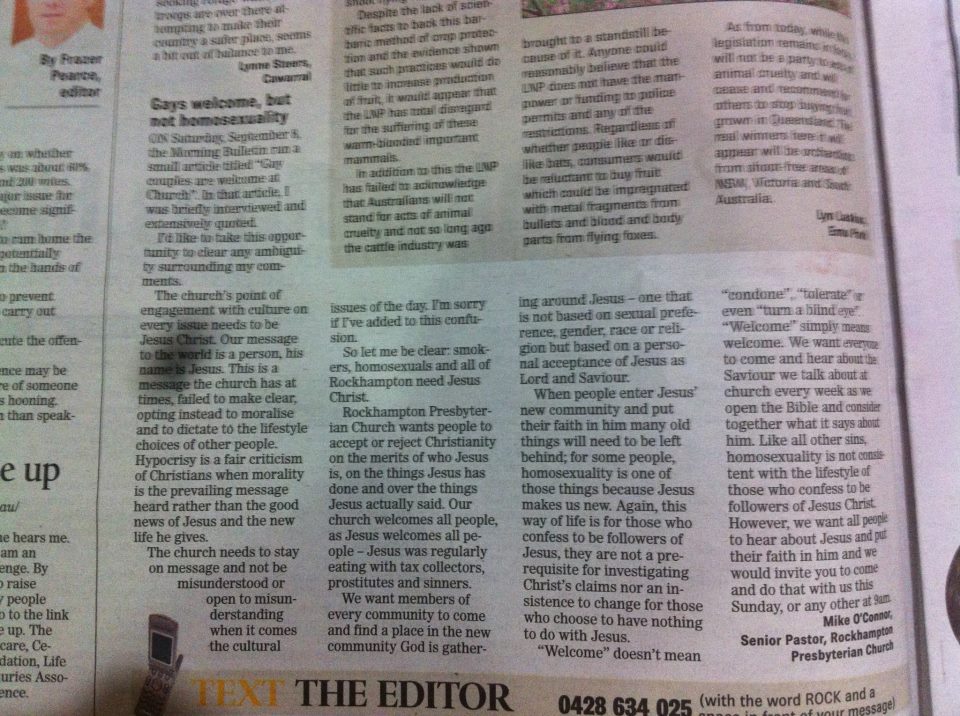
Here’s the text:
Gays welcome, but not homosexuality
On Saturday September 8th, the Morning Bulletin ran a small article titled “Gay couples are welcome at Church”. In that article, I was briefly interviewed and extensively quoted.
I’d like to take this opportunity to clear any ambiguity surrounding my comments.
The church’s point of engagement with culture on every issue needs to be Jesus Christ. Our message to the world is a person, his name is Jesus. This is a message the church has at times, failed to make clear, opting instead to moralize and to dictate to the lifestyle choices of other people. Hypocrisy is a fair criticism of Christians when morality is the prevailing message heard rather than the good news of Jesus and the new life he gives.
The church needs to stay on message and not be misunderstood or open to misunderstanding when it comes the cultural issues of the day. I’m sorry if I’ve added to this confusion.
So let me be clear: smokers, homosexuals and all of Rockhampton need Jesus Christ.
Rockhampton Presbyterian Church wants people to accept or reject Christianity on the merits of who Jesus is, on the things Jesus has done and over the things Jesus actually said. Our church welcomes all people, as Jesus welcomes all people – Jesus was regularly eating with tax collectors, prostitutes and sinners.
We want members of every community to come and find a place in the new community God is gathering around Jesus – one that is not based on sexual preference, gender, race or religion but based on a personal acceptance of Jesus as Lord and Saviour.
When people enter Jesus’ new community and put their faith in him many old things will need to be left behind; for some people, homosexuality is one of those things because Jesus makes us new. Again, this way of life is for those who confess to be followers of Jesus, they are not a prerequisite for investigating Christ’s claims nor an insistence to change for those who choose to have nothing to do with Jesus.
“Welcome” doesn’t mean ‘condone’, ‘tolerate’ or even ‘turn a blind eye’. ‘Welcome’ simply means that: welcome. We want everyone to come and hear about the Saviour we talk about at church every week as we open the Bible and consider together what it says about him.
Like all other sins, homosexuality is not consistent with the lifestyle of those who confess to be followers of Jesus Christ. However, we want all people to hear about Jesus and put their faith in him and we would invite you to come and do that with us this Sunday, or any other at 9am.
Mike O’Connor
Senior Pastor
Rockhampton Presbyterian Church
So, for anybody who says it’s not possible to be clear, winsome, speak against homosexuality (or at least call it sinful), and for Jesus – here’s a bit of published evidence to the contrary.
Tying up some loose ends around here before I return to serving up YouTube videos which is just about the limit of what my mental capacity can handle for the next few weeks, I just wanted to lay out some of my thinking about what the relationship between my last career (which I still do a bit of) in Public Relations, and my future vocation – gospel ministry.
I’m increasingly aware not just that there’s a gap in the market for thinking about how churches engage with the public via the media (a subset of PR), and not a huge number of resources out there for thinking about what Christianity looks like in the Media. CPX does a great job, the Sydney Anglicans, and especially Peter Jensen, have some resources, which we saw come into play on Q&A this week, and Communicate Jesus is a great first step for thinking about how to communicate timeless truths in a timely way.
I’m also aware that for many people “PR” is synonymous with “Spin” and deliberate deception, or providing inane sound bites so that you’ll get picked up in the news cycle. These are essentially antithetical to Christian ethics, and the message of the gospel. Though clarity and being succinct is important.
I also mentioned in my post about what college is teaching me that I’m increasingly reflecting on how proclaiming the gospel benefits from understanding culture. I want to flesh that out a little in this post – particularly as it relates to how I think about public relations and whatever skills I might have there.
So – in a nutshell – I think Paul, in his rejection of Corinthian sophistry (see B.W.W Winter, Paul and Philo amongst the Sophists) turned to Cicero, who in De Oratore had rejected flashy, substanceless, but impressive oratory that majored in pathos, for an approach to oratory that focused as much on ethos (the character of the speaker), and logos (the substance), as pathos (the ability to stir an emotional response). I think Paul was a highly trained, though non-professional rhetorician who became a Pharisee because he couldn’t professionally advance as a Jewish orator, and this explains the rhetorical power of his letters, and his impressive presentations to councils, kings, and court rooms in Acts.
I think his appearance in the marketplace, and then the Areopagus, in Athens is, by analogy, the first century equivalent of blogging, media engagement, speaking to parliament, and going on a TV talk show.
I think he benefited from recognising a truth in Cicero, also present in the work of the prophets etc – where value was placed on character and developed this to emphasise a Christ like suffering character (and I think that explains his words in 2 Cor 10-13 – you can read more in my essay here). I’d argue that in some sense he has “plundered the gold of the Egyptians.” Which is a concept that Augustine pushes pretty hard when he tells Christians to get a good “classical” education in De Doctrina Christiana (On Christian Teaching – again, you can read more of my essay here).
“…all branches of heathen learning have not only false and superstitious fancies and heavy burdens of unnecessary toil, which every one of us, when going out under the leadership of Christ from the fellowship of the heathen, ought to abhor and avoid; but they contain also liberal instruction which is better adapted to the use of the truth, and some most excellent precepts of morality; and some truths in regard even to the worship of the One God are found among them. Now these are, so to speak, their gold and silver, which they did not create themselves, but dug out of the mines of God’s providence which are everywhere scattered abroad, and are perversely and unlawfully prostituting to the worship of devils. These, therefore, the Christian, when he separates himself in spirit from the miserable fellowship of these men, ought to take away from them, and to devote to their proper use in preaching the gospel. Their garments, also —that is, human institutions such as are adapted to that intercourse with men which is indispensable in this life — we must take and turn to a Christian use.”
Luther followed suit a little bit, he was particularly keen to communicate in forms that worked, and part of the nature of their “working” was their popularity. He even liked fonts. He sent a letter to one of his rich friends that said:
“have some boy collect all the German pictures, rimes,songs, books, lays of the Meistersinger, which have this year been painted, composed,made, and printed by your German poets, publishers, and printers. I have a reason forwanting them. We can make Latin books for ourselves, but we wish to learn how tomake German ones, as we have hitherto made none that please anybody.”
He didn’t just use pop culture, he also played the media relations game, or its equivalent.
Here are some stats about his use of the printing press during the reformation (read more in my essay here).
It is estimated in the first three years, 300,000 of Luther’s 30 popular pamphlets were circulating,and by the tenth year, two million copies of Luther’s 400 plus pamphlets were circulating, not just in Germany, but throughout Europe. The Reformation led to a sixfold increase in output from German printers.
These were published in the vernacular, and aimed at the public, not the elite.
The case for making PR, which is a modern form of “communication” and an academic discipline an example of this “gold” means establishing that it is actually a redeemable thing… and not just saying whatever it takes to get people to believe whatever you want.
First off, it’s worth making the distinction between “media relations” and “public relations” – media relations is a subset, an important subset, of PR, and its really where my expertise lies. But media relations will be a bit piecemeal, and disconnected from an organisation’s priorities – or in this case the mission of the church – if it isn’t part of a bigger communications plan that considers what your message is, and what its implications are for the public, and how you’re going to communicate your message so that the public understands it.
I was a Christian before I started working – so my approach to PR, and my PR ethics (and before that, my approach to journalistic ethics which I thought about while at Uni) were shaped by my faith. I think this actually made me better at my job, because I think the murky side of PR which is caricatured as “spin” and prides itself on not answering questions with anything but a repeated “key message” or not engaging with criticism is a communications cul de sac, which will hopefully eventually die out when people realise what sort of politics and public discourse it produces, and that it erodes the very trust that PR should be seeking to build. I think that’s starting to happen. I was more interested in full, and pre-emptive, disclosure of stuff that went wrong, never lying by commission, or omission, showing how key messages related to issues, questions, and real life for real people, and maintaining a relationship with journalists and the public by generally being trustworthy. This didn’t always happen, and it may be that I’m incredibly naive.
Conforming to the type of PR that involves essentially selling one’s soul and becoming a robotic sound bite speaker driven by self interest, or the desire to win, or conforming our message to whatever medium we’re speaking to – so, for example, going on Q&A to score cheap points by insulting the views of the people next to you, rather than listening to what’s being said and offering a gentle opinion – would be a case of turning the gold we plunder into a golden calf (see this Matthias Media piece on being mindful of how we use “gold”).
So when I talk about PR I’m essentially assuming this worldview, and this definition. Which isn’t always what other people are operating with.
But what are the implications for this? I’d say we need to think about how we do the media relations part (and you can read my thinking about how to do that here), but that needs to be a subset of thinking about communication, of our key message (the gospel, how king Jesus changes lives through his death and resurrection and the launch of his not yet fully realised Kingdom), how it relates to our audience (everybody), and the manner in which we’ll communicate this (I’d suggest Paul’s “all things to all men” 1 Cor 9:19-23). I think we need to think about what theoretical frameworks or disciplines we can use – like Augustine – and what mediums we can adapt – like Luther.
The media engagement stuff is useful, in a sense, without this sort of thought and planning. If you have an event you want to promote, or something. Which is why I write how to posts. But it gets supercharged when you plug it into some strategic thinking about how you’re going to communicate to the same person in an attempt to build, or nurture, a relationship with them. A relationship doesn’t have to mean you know their name, or have their phone number, that would be nice – but a “brand” type relationship means they don’t just know who you are, but have some idea of what you stand for, and how that is relevant to them. This is what “public relations” is about.
Public relations ultimately isn’t so much about knowing how to say what you want to say. It’s about knowing why you’re saying something, and who you’re saying it to. This is where having some sort of Public Relations or Communications Strategy for your brand – in this case, your church, which is essentially a subset of a much bigger franchise – is essential. We’re never going to be able to sit down and get a universal “Communication Strategy” for the church beyond the Great Commission – so I’d argue each church has a responsibility to think about how it communicates the gospel as part of its call to participate in the Mission of God.
A Public Relations strategy starts with identifying what it is that you, as an entity, want to communicate, and why. I’d say that’s relatively easy for us in the first instance. It’s the gospel. But then it should probably include what you want to communicate as your church’s distinctives – what’s your point of difference from other churches, on the basis of your context, or theological convictions. What do you “do” that you want people to know about before they come into your doors? What do you do that you want people to know about when they come through your doors (at Creek Road we have some really helpful “Plumb Lines” that describe our approach to church).
Then it identifies “who” you want to relate to – and should include internal stakeholders – our members, leadership teams, elders, staff, as well as our external stakeholders – the people in our community, non-Christian friends and family members with some association with the church, the people of our state and nation… and what sort of channels we’d use to talk to them in the most authentic and relational way possible.
Then it moves to “how” best to relate to these groups – you’re probably best off relating to as many of the internal stakeholders face to face, or as “authentically” as possible. Your communication should be a reflection of your relationship. So it’s ok to communicate to people you don’t know in the pages of your local paper, but it’s probably not a good idea if your elders are finding out about changes at church when they sit down with the paper for a cuppa. This means, for external people, knowing the demographics of your area, and knowing what sort of channels those demographics use to learn stuff – so to caricature a couple of generations – talk back radio for the oldies, Facebook for anyone under 25…
Once you’ve got the strategy sorted out – you can produce a communications plan – so that what you’re doing integrates with what you’ve decided you should be doing. Steve Kryger at Communicate Jesus posted up one week of his Communications Plan for Church By The Bridge. It’s a really useful example of what applying some thought looks like, and once you get to that stage having some idea how to do things like putting together an email newsletter, or writing a media release, or doing stuff on social media, is really useful. You’ve also got to figure out how often you want to be communicating with people – both those who are on your team so that they stay on the same page – and those outside so that they develop a picture of who you are and what you stand for.
This is what I think when I use the words “Public Relations” – this sort of strategy, planning, and doing – not just the doing. I don’t mean the shadowy stuff where you’re sort of pulling the strings to create opportunities to be heard, or coaching your spokespeople to stay on message and not look silly doing it, or cleaning up the mess in a crisis – though these are all aspects of what PR is.
Public Relations – like this – is useful for getting the members of your church family working together and knowing what you’re on about when they’re out being ambassadors for Christ in your community, it’s useful for managing changes – large or small – in your congregation and the way you do stuff, and it’s useful for presenting the gospel in a way that people have information communicated to them in your community. That’s why I think this is gold worth plundering.
I guess part of the reason I’ve written this post is because I realise that I’ve focused on the “how” more than the “why”… and that’s potentially unhelpful.
Here are some of the things I’ve written about why we should do PR, and the substance of our “message” from my Public Relations resources page
Here are some “how to” posts

Wow. Just wow. Look, Peter Jensen said tonight on Q&A that he supports the ACL – I’m going to write to him and ask him to support them with some PR advice. Just wow.
While every word he spoke was seized on and ridiculed by Catherine Deveny, Peter Jensen winsomely, faithfully, and articulately, presented the gospel and called for a more respectful public discourse about serious issues.
Let me just start by articulating, lest there be confusion, why I think Peter Jensen did a good job while saying substantially the same thing as the ACL.
He talked clearly and winsomely about Jesus and how the gospel impacts our social position. Not on all issues – Jesus was almost absent on his treatment of Asylum seekers – though his love for others wasn’t – and he said that it wasn’t “unChristian” to seek asylum”… he also talked about things in a measured way and talked about wanting to improve the tone of conversation around these issues – I don’t think the ACL models this well, and they certainly talk about Jesus much less than Jensen did, and does. A friend suggested that my favourable response to Jensen, when he not only endorsed the ACL, but took the same position as them, was possibly a result of bias, or that it would be perceived to be the case. But let’s walk through last night’s program and see how the Archbishop did (this friend didn’t actually watch until the end, and I thought it got better as it went along).
On Asylum Seekers
I think this was where what I am guessing was a strategy that Archbishop Jensen employed to demonstrate that careful engagement isn’t the order of the day on Q&A – he has been, perhaps rightly, criticised for being a little waffly – but I think he may have been inviting people to interrupt. He’s typically incredibly well briefed and sensitive to different mediums. There’s also this:
Peter Jensen requested to be seated next to me on #qanda last night. Any ideas why?
— Catherine Deveny (@CatherineDeveny) September 11, 2012
Which is interesting. So I think he’s subverting the medium to make a point about public discourse.
ROSS GRENFELL: Archbishop Jensen, do you agree with Tony Abbott’s comment that good Christians would not use the back door in relation to asylum seekers using boats? After all, weren’t Mary, Joseph and Jesus undocumented asylum seekers when they fled to Egypt to escape Herod.
TONY JONES: Peter Jensen?
PETER JENSEN: No, I don’t agree with it and I do agree they were refugees and Christians ought to be extraordinarily sensitive to refugees and their needs. I agree with all those things. Can I go on?
TONY JONES: Yes, of course.
PETER JENSEN: I thought you might allow me. I do think, in terms of our political discourse, I’m sorry we can’t let the Government change its mind and get away with it because, after all, when new facts come in we’ve got to have people to change their minds.
In the light of my recent posts on asylum seekers I will say, that apart from tone, in the black and white form of the transcript, Catherine Deveny made some solid points, given extra credibility off the back of her recent Go Back To Where You Came From appearances.
Catherine Deveny: …This is very easy. This is not about stopping the boats, this is about starting the planes. This is about processing in Indonesia and in Malaysia. There is no deterrent that you can set up in Nauru or Manus Island or Christmas Island that is going to stop those people getting on boats. They say to me – every single one of them has said to me, “I would be happy to be swallowed up by the ocean than go back to where we’ve came from.” You have no idea what these people are facing. It is extraordinary that we’re not doing our basic obligations as signatories to the UN Refugee Convention. We shouldn’t just be doing what the UN suggests we should be doing, we should be doing so much more. We have so much to give. This is a country that has been built on boat people, as they call them. I don’t see boat people. I just see people.
There was a nice moment where Peter Jensen promised to hold the government to account on its treatment of asylum seekers according to a recent report – which he had read, and could engage with.
CHRIS EVANS: Well, as I say, you can’t put a length of time on it. We don’t honestly know but in implementing the whole package one would hope that the deterrent value would start to see a change in behaviour. It’s one of the reasons why I think the…
TONY JONES: All right. So, no, just having elicited that answer I just want to hear from Peter Jensen. Are you satisfied with that, no time limits?
PETER JENSEN: Yes, well, I’ve had a look at the report. The spirit of the report is saying something a bit different, I think, Chris, and I trust that as you implement it you will be there’s nothing like hopelessness.
CHRIS EVANS: No.
PETER JENSEN: And to have arrived at Nauru and to have Australian protection in that sense, I know it’s an independent country, but to have no timeframe will breed the hopelessness that leads to self-destruction and to depression. So I would be looking for something better than that if possible, I have to say, and I think that’s the spirit of the Aristotle-Houston report.
I actually thought Chris Evans was worse to listen to than Catherine Deveny.
The Archbishop’s gospel contribution began in earnest on the question of the Sydney Anglican’s alternate marriage vows.
ELIZABETH ANNE SMITH: As a young woman and feminist living in the 21st century, where everyone is entitled to equal rights, I would like to know what valid reason the Church has to request a wife submit to her husband in marriage.
TONY JONES: Peter Jensen, let’s start with you since you started this debate.
PETER JENSEN: I thought it might be me. Yes. Thank you very much. Thank you for the question. Really I mean that, because at long last we’re beginning to have a conversation which sounds as though it’s going to be a rational and serious conversation about the nature of marriage and I have to say, from my point of view and perhaps some others as well, the whole question of marriage and family is one in our community that needs careful thought. Now, when I say the Church, by the way, we have put forward a possible service for use. It’s not mandatory. It’s an alternative. Let me say that. What we’re seeing, I think, is a clash of world views between what I’d call individualism and what you may call family or, in a sense, community. It’s a clash of world views which is going on all around us and it has drastic consequences one way or another. If you agree with me that a man is a man and a woman is a woman and although they are we are absolutely equal, equal in the sight of God, both made in the image of God, both with the same destiny, both with the same value, all those things are inherent in the Christian gospel and they must remain in the Christian gospel, agree with that and yet, on the other hand, I would say there are differences between men and women which both sides bring to a marriage and we have not been good recently at working out what it is that men bring to marriage and women bring to marriage.
This was perhaps my favourite moment of the night, Tony Jones treats his guests with thinly veiled contempt a little too often…
TONY JONES: Okay. Let’s just get to the heart of the matter and to the question. Now, you’ve said biblical teaching is that the bride can make a voluntary promise to submit to her husband. So what exactly does the word “submit” mean to you.
PETER JENSEN: Well, it is a biblical word.
TONY JONES: Well, it’s an English word, actually. It would have been in Hebrew in the Bible.
PETER JENSEN: I don’t know quite how to tell you this, but it was Greek actually, if that’s all right but don’t worry
Then there was this:
PETER JENSEN: If submission is in view, it is because a husband has made certain key promises. This is more about men than it is about women and it is about a concern that men are not being men in the community. What men bring to marriage, what men bring to anything, is that sort of physical strength, if you like, a certain degree of arrogance, a certain degree of determination to be bossy, et cetera, et cetera, et cetera. What men are being asked – they were asked something before the women say anything. What men are being asked is will you live towards your wife like Jesus Christ who gave his life for his bride. Will you do that? And if the man says yes to that and only then, otherwise I would not recommend it, if a man says yes to that and so commits himself, then I believe it’s right for a woman, if she chooses to, to say I submit to that in the sense that I recognise it, I respect it, and I’m going to give you space in our marriage – I’m going to give you space in our marriage to be a man.
As Tony Jones turned to Catherine Deveny in response to this Peter Jensen showed he had been briefed, with a reference to a tweet she put out a week ago.
I'm never married. I oppose marriage but support #marriageequality because marriage is a mistake everyone has the right to make.
— Catherine Deveny (@CatherineDeveny) September 5, 2012
PETER JENSEN: Now, you believe in marriage.
CATHERINE DEVENY: No, I don’t.
PETER JENSEN: That’s an important first point.
CATHERINE DEVENY: I don’t believe in marriage.
PETER JENSEN: You don’t believe in marriage.
CATHERINE DEVENY: I’ve never been married but I’m a very big supporter of same-sex marriage because I believe that marriage is a mistake that everyone has the right to make. I have never been married but I would like to congratulate you on your decision to proudly fly the misogynist and medieval colours of your religion and I do support your right to discriminate within your religion. And what I think is great is that you can choose to go to Las Vegas and be married by an Elvis or now you can choose to go to the Anglican Church and be married in a museum by a dinosaur….
So I think it’s interesting that you guys are going for a niche market there. I mean you guys could have gone for the Gloria Jeans, the corporate rock, the Hillsong, the ‘Be awesome for Jesus’ but you’re going, ‘No. No. Men are in charge because of the mumbo jumbo.’ So congratulations.
TONY JONES: I think you ought to be able to respond to that but briefly I just want to hear the…
PETER JENSEN: Where would you start to respond to that? I’m looking for a respectful and serious discussion of very important issues.
CATHERINE DEVENY: That is respectful.
PETER JENSEN: And we get dinosaurs and this sort of stuff. Interestingly, in the churches for years now we have not been using this language and we’ve gone down to 30% of the market.
CATHERINE DEVENY: Mm, the market.
PETER JENSEN: I’m saying, no, I think there’s a clash of – I think it was your word. I think it’s a clash of cultures here, very important. I may be wrong about all this. I’m only human. I think it’s important.
That my friends is epistemic humility. It’s disarming.
BRONWYN FRASER: Hi. I work with Christian cultures – women in Christian cultures overseas who do have this biblical wife submission approach to marriage and they also report some of the highest levels of domestic violence and sexually-based violence. Up to 60% of the women have experienced this. Could it be that this sort of inequality in marriage can lead to domestic and sexually-based violence and, as a Christian, how does this actually represent what Jesus stood for?
TONY JONES: Peter Jensen?
PETER JENSEN: Yep. I believe this, again, gets to the heart of issues that are very important and can I say I utterly abominate the whole idea of domestic violence. I think it’s a wicked thing and any person – particularly any man who lays his hand on his wife is, to my mind, committing a grave sin. So that is what I believe. Now, is my view contributing to that end? I trust not because, properly understood, my view is saying that no man could ever do that, that it’s really he is to behave towards his wife as Jesus Christ behaved towards the Church.
He was again humble and open to discussion on gay marriage.
“PETER JENSEN: Yeah. Yeah. And again there’s an argument for this and it’s one that we ought to conduct in the right spirit, I believe, and with give and take and listening to the whole matter. I do…
TONY JONES: So you have an open mind about gay marriage?
PETER JENSEN: Well, I have the same open mind most people have about most things. Namely, with a good argument you may change your mind but for the moment you keep going down one track.”
Then it got really interesting, for me, anyway, given the last week… I take some solace from the bolded bits…
PETER KEEGAN: The Australian Christian Lobby has again made the headlines for offensive remarks made by its director, Jim Wallace. As a Christian, I continually find that the ACL does not speak for me and does not represent the kind of faith that I see reflected in the teaching and ministry of Jesus. Archbishop, will you publically say that contributions like those we heard from the ACL pose a greater risk to the health of our public discourse and the integrity of our faith than the presence of lifestyles or beliefs that may differ from our own?
PETER JENSEN: Again, thanks for the question. No, I won’t say that. I am generally supportive of ACL, I have to say. I don’t support everything that’s said by its leaders.
TONY JONES: What about this very specific statement where Jim Wallace suggests that homosexuality poses the same kind of health risk to the community as smoking does?
PETER JENSEN: It needs to be observed that he has been somewhat quoted out of context in some reports. I’m not sure about that one but in some reports he’s been somewhat quoted out of context. But what he has done for us, rightly or wrongly, what he has done is given us an opportunity to talk about something significant, namely the question of health risks. Now, I think it is true to say – I think it is true to say – it’s very hard to get all the facts here because we don’t want to talk about it and in this country censorship is alive and well, believe me…
In response to a gay teenager, brought up in a Christian home who explicitly cited the rejection from his Christian community as the reason for his suicide attempt, the Archbishop had this to say… I loved the last bit, because it’s what I’ve been arguing our response should be.
ALISTAIR CORNELL: My question is for Peter Jensen. I was born and bred Anglican but at the age of 15 I tried to take my own life. What advice would he give to a 15 year old suffering almost to the point of death from the rejection of his community about being gay?
PETER JENSEN: Thank you and thank you for the courage of coming on and telling us that story. You see, one of the difficulties is to get that story, to get it to someone like me and to give me the chance to assess it for what it is…
…
PETER JENSEN: Well a 15 year old sorry, I need to be careful here. We don’t want to talk about this particular young man with his courage. But clearly a teenager is going through a period in their lives, exciting as it is, in which they’re seeking to find themselves. A person who feels in themselves same-sex attraction and I might add, a lot of such folk have talked to me over the years, is seeking, I think, to find themselves, to find an identity and in our sort of society, with its emphasis on sexual activity as an identity finding activity, there is therefore the opportunity to think that that is the way to do things and yet here you have this frowned upon same-sex feeling.
TONY JONES: Okay, I’ve just to interrupt because we do need to hear other panellists on this subject but put simply are you saying or repeating, in a way, or making, you know, a sort of more complex argument about what Jim Wallace said, which is homosexuality is bad for your health? Are you seriously trying to make that argument tonight?
PETER JENSEN: I would like to know see, people tell me that it is and they produce literature on the subject. I can’t get a discussion going on this because it’s a forbidden subject. Now, I’m open on this. I hope it’s not true, Tony. I don’t want to see my friends dying and I’ve seen my friends dying. I don’t want to see that. I don’t want to hear stories like that. But, dear friends, sorry, when do we get to the point where we can talk about this without shouting at each other and hurting each other?
This bit was helpful too…
TONY JONES: Well, can I just ask, presumably you’ve looked at some of the science around the health statistics, have you actually looked at the science about the gay gene which suggests that it is intrinsic in a person their sexuality and if you’ve looked at that, I would ask you this: if God actually created homosexuals, would you not then have to turn around and change your mind on all of these issues?
PETER JENSEN: Thank you, Tony. God did create homosexuals. I don’t need the gene to tell me that. God created homosexuals. God created every person and loves every person, without doubt.
TONY JONES: No, I mean he created if there is a gay gene, would you say the creator was responsible for creating that?
PETER JENSEN: Well, I would say that that that may be the case but we’re not talking about same-sex attraction, we’re talking about the acting out of same-sex attraction. We’re talking about well, I realise that we’re living in a very, very different world from the one I’m talking about but I’m living in a world where a number of my friends have life long committed themselves to no sexual relations.
Then we were on the home stretch – atheism and proof of God’s existence.
“CATHERINE DEVENY: For me, I mean, you can took about proof and there’s no proof. I mean one of the things that I always think about is like if God exists why doesn’t he show himself? But when you actually look at the Bible, which is – that’s the only text that I’m – like, religious text that I’m really familiar with, it is basically social engineering embedded in fairytales and horror stories which is just chock full of homophobia, misogyny, discrimination and division and most people haven’t even read it. It has been written by 44 – you know, 60 people, I think, 44 chapters, you know, three different languages over thousands of years, thousands of different interpretations and despite all of those different interpretations, the only thing they can all agree on is homophobia, misogyny, discrimination and division. So, I’m sorry, the way that I see it, it’s just been a very, very handy way to keep people in their place, particularly women, homosexuals and people who don’t believe what they believe.”
Then there was this. Pure gold. Christ centred gospel in the face of the chatter of Catherine Deveny who couldn’t resist scoring cheap points with angry soundbites. This is why I’m so very happy with last night. I know most people agree with Catherine Deveny’s assessment that the church is out of touch on social issues – you only have to look at the comments on this post that went up when it was just my tweets… but that’s not the point. Winsomely, and gently, responding to criticism and seeking a conversation where you can get to this point – having argued your position on social issues on the basis of Jesus and the gospel all the way through – that’s why this man is an example for how to, as John Dickson says, do public Christianity.
Peter Jensen on Q&A – the best public Christianity I've seen. Pure grace & intellect under fire.
— John Dickson (@johnpauldickson) September 10, 2012
PETER JENSEN: Okay. Has God shown himself? Yes, I believe he has and I believe he’s shown himself in Jesus Christ. I believe if you want to know examine his life, examine what he said, examine his miracles and that’s where the big issue is. Come back to Jesus Christ and examine his life, examine what he said, examine what’s around him. I have to say that Catherine’s account of the Bible is as fanciful as a tooth fairy. It’s got no bearing on the reality of the Bible.
CATHERINE DEVENY: You mustn’t have read it.
PETER JENSEN: Yeah, I’ve read it a bit. And really the big look, I tell you what, the big story of the Bible is just as simple as anything. Jesus Christ came into the world to save us and he is God amongst us. What more could we ask? I tell you what, it’s the most gracious I’m so sorry you’ve got your view of it.
CATHERINE DEVENY: You said, “What more could we ask?” Equality, that would be good.
PETER JENSEN: Well, we’ve got it because every man and woman…
CATHERINE DEVENY: I’m sorry, a white middle class man like you does have it. Try being disabled, try being an asylum seeker, try being gay, try being a woman, you’ll find it’s not there.
TONY JONES: Okay. All right, Catherine. No. No. No. No. Okay. All right. Sorry, I said we’d give him the last word. I didn’t mean…
CATHERINE DEVENY: Yeah, I think he said plenty of words.
PETER JENSEN: Well, the last word is that in Jesus Christ we have that equality and in Jesus Christ was have that salvation and all I can say is the most wonder that the love of God for everyone, no matter who they are, no matter how they’ve lived or whatever, is the greatest reality in the world.
Gold.
Here are my tweets from during the show.
"call it queue jumping, call it what you will" – how bout we call it "seeking asylum" #qanda
— Nathan Campbell (@nm_campbell) September 10, 2012
Wow. Peter Jensen talked about civilised conversation. And then we turned to Catherine. #qanda
— Nathan Campbell (@nm_campbell) September 10, 2012
I love Peter Jensen's epistemic humility. "I might be wrong about this"…
— Nathan Campbell (@nm_campbell) September 10, 2012
Deveney speaks to Jensen mockingly. Jensen doesn't respond in kind. There's a worldview in operation.
— John Dickson (@johnpauldickson) September 10, 2012
I would, had I my preference, get rid of the others and just have Peter Jensen and Anna Krien. They seem interested in conversation #qanda
— Nathan Campbell (@nm_campbell) September 10, 2012
It's weird Catherine. I thought this was a question to Peter, and suddenly you're talking… #qanda
— Nathan Campbell (@nm_campbell) September 10, 2012
Ooo. This will be interesting. Archbishop Jensen on the ACL…
— Nathan Campbell (@nm_campbell) September 10, 2012
Gee Peter Jensen is winsome. #qanda
— Nathan Campbell (@nm_campbell) September 10, 2012
Chris Evans, let me google that for you here's a study from Oxford: http://t.co/BjBLFSZs #qanda
— Nathan Campbell (@nm_campbell) September 10, 2012
Why are you asking an Anglican about condom use? Seriously. There was this thing called the reformation #qanda
— Nathan Campbell (@nm_campbell) September 10, 2012
Christianity is about Jesus. Yes. #qanda
— Nathan Campbell (@nm_campbell) September 10, 2012
Whatever social capital Deveny banked on Go Back To Where You Came from was just spent on #qanda
— Nathan Campbell (@nm_campbell) September 10, 2012
I’m disappointed this is the summary from the SMH.
David Ould was in the audience last night and had this to say.