I’ve finally found a plug-in that does what Simone wanted… a simple “like” plugin.
The star rating thing hasn’t really taken off, but I’m keeping it for now. You can “like” a post by clicking the little plus symbol down the bottom.
I’ve put together a few tips for helping husbands/wives to survive the report writing process.
For the report writer.
1. Balance your time. We all know that report writing isn’t fun for you, but don’t forget that it’s no fun for your spouse either. Make sure you spend some quality time with them as well.
2. Encourage your spouse to use some of his/her free time to do the things he/she enjoys but you don’t. For Nathan it’s playing playstation.
3. Don’t slack off on your commitments. Again, this has to do with the balance thing. Fair enough, don’t take on any extra commitments, but don’t slack off on the ones you’ve already committed to.
4. 80% is good enough. I haven’t mastered this one yet but I’m trying. Apparently the theory is that near enough is good enough. We don’t have to be perfect all of the time.
5. Sleep and eat properly. This goes without saying.
For the spouse…
1. Be patient and understand that the work needs to be done at home and outside of regular work hours.
2. By flowers and chocolate. Frequently.
3. Try to provide a healthy dose of perspective.
4. Be prepared to get your hands dirty and do some marking.
5. Find something to occupy yourself for 72 hours. Nathan recommends a PS3.

So far I’ve raised $5 with my really useful gift shop. And I have to confess that I spent that $5 myself. On a fish called Eutychus – or a fish farm full of fish called Eutychus.
I’m not expecting to reach the heights of stuffchristianslike.net – or in fact any heights at all – but I am going to keep the little logo for the shop on the top right of the page. Probably forever. In the hope that one day somebody will buy one of these $300 cows.

The astute followers out there may have noticed that it has been a whole day since I’ve updated my report timer. There’s a good reason I haven’t updated it. It’s the same reason I was able to nap yesterday afternoon for two hours, go to the movies today and appear in public without the fear of getting grumpy at somebody for no particular reason. Those dreaded reports are finished! And I think we’ve come through relatively unscathed.
Here’s a little summary of how they went. I’ve done it in list form, as that seems to be the way things are done around here.
There you have it. The reports haven’t actually been approved yet. That process can take a day or it can take three weeks. I really hope it’s the former. For those of you who are parents out there, I’m expecting to see a few framed report cards hanging on your living room wall. They cost a lot.
* By outside of work hours, I generally mean from 5pm onwards. My school day typically lasts from 7.30am – 4.30pm. As my teaching load remains exactly the same during report writing season, so do my hours.
This is, as the heading indicates, the number four in a series of five posts. Here are all five tips, and here’s my post on the first one, here’s the second one, and here’s the third.
As we discussed in tip number one – nothing kills a blog like a loss of momentum. I think this tip is particularly important in the early stages of a blog.
Blogs aren’t a great medium for people wanting to publish polished essays every time. Some posts are going to be not as good as other posts.
More often than not it’s the posts I think are a bit rubbish that get a spike in traffic or see increased comments.
The best solution I’ve come up with in order to keep my blogging juices flowing is to just post. As often as possible. This means I’ve written some absolute rubbish in my time, which on the whole has contributed to the quality of this blog in a negative manner. But, I’ve also managed to stick at blogging for almost 4 years and almost 2,600 posts.
My post rate, and my traffic, have picked up since I decided to take the “just post any old thing” approach…
I have one or two rules that I use when deciding whether or not to post something. There is a limit to how stupid my posts can be without cheapening the experience of visiting this site.
There’s an important overarching precept guiding my posts – I am a Christian before I am a blogger, and this creates a tension… I want to glorify God with this blog – and I use it as a vehicle for articulating my thoughts on what I’m learning or thinking about Christianity. But I also like posting really silly things. Things that are probably at the pinnacle of human stupidity. And toilet humour. Having two columns has helped me come to grips with this tension – it probably doesn’t help feed readers.
I am, in this post, dealing with my tip to be prepared to post stupid stuff, I’m not sure that I see this stupid stuff as a way to do anything but keep momentum going and perhaps entice people here to be amused – I suspect more people come for the stupid stuff than for the thought out stuff.
Here is, for want of a better label, my checklist for posting a stupid post.
I subscribe to Dinosaur Comics. I read them most days. I find them vaguely amusing about 60% of the time and laugh out loud amusing about 2% of the time.
Today’s comic, and the associated diatribe about the way old people handle stories about young people and technology made me laugh. The story it’s responding to is this one about a young guy who used an updated Facebook status as an alibi. You can’t get that from the comic…
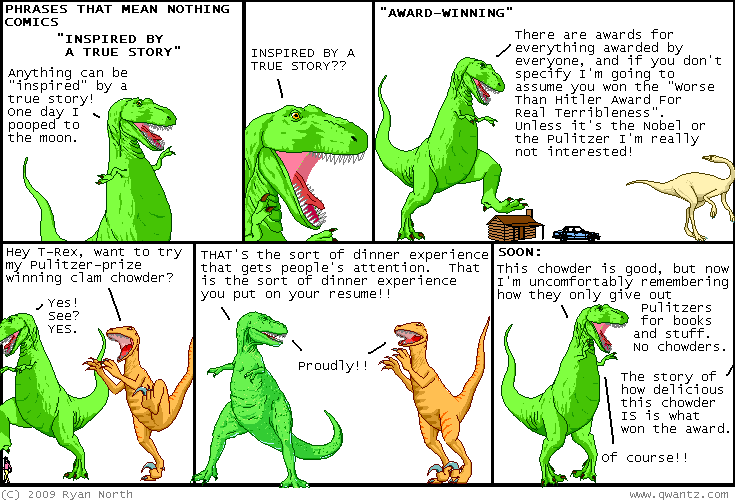
But the associated editorial spells it all out…
But as that article goes on, it slides deep into “oh man OLD PEOPLE STEREOTYPES” territory. Joseph Pollini, who otherwise sounds awesome because he lists “hostage negotiation” as his primary area of expertise, says that teenage HACKERS could have posted that pancake-centric Facebook update to Rodney’s profile while posing as Rodney at his home computer, while Rodney was actually out busy robbing at the time – which, you know, is possible? But it’s not very likely, and it takes some knowledge. No problem, says Joseph! Teenagers are really good at internet, because “they use it all the time”. “They [teenagers!] could develop an alibi. They watch television, the movies, there is a multitude of reasons why someone of that age would have the knowledge to do a crime like that.”
ABC Radio up here in Townsville has an amusing weekly segment with a local lady in her twilight year (how do you say “old” in a politically correct manner?). Last night she was talking about kids and their fat thumbs that come from an insatiable desire to play the latest greatest games.
I think future children are going to be playing the games their fathers give them. The old old generation miss the point that the new old generation embrace technology the same way the new new generation do. Though I suppose there’s a difference between the way even my youngest sister approaches technology and the way I do.
Mark Driscoll, when he was in Australia, made a comment about faith – one generation wholly owns it, the next accepts (or assumes) it, and the next denies it. I think technology works in reverse.
Let us, for a moment, take a look at my family as a case study…
My dad was a classic early adopter. He was an electrical engineer which put him at the front of the curve when it came to developing computer technology. So far at the front of the curve that he wrote a book about one of the first computers. This, through a variety of circumstances detailed in that link, led to a lifetime of early adopting. His generation (and to be kind, the one before it) built the computer industry.
This in turn meant that I grew up experiencing a heap of new computer products and games. I think I wrote my first assignment using the Internet (CompuServe) in 1994. It was about Rwanda. It was, on reflection, possibly the best assignment I ever wrote (except maybe for the self help guide to writing self help books). I like technology. I use technology. I find technology incredibly useful. I think, though this hasn’t really been tested, I could function without it.
My generation benefited greatly from the work of the generation previously – and many of us (not me) are now internet millionaires and billionaires because we missed the first dot com boom and caught the second. We are also a generation of hackers and pirates who believe technology should work for us, not us for it.
Meanwhile the next generation down couldn’t really live without it. Lets take little sister number three as an example. I suspect if I stole her mobile phones (that’s right, plural) she’d go into meltdown. She can correct me if I’m wrong.
Her generation have grown up immersed in technology – some of them have one mobile phone with a bunch of different SIM cards based on who they want to call on free deals. They have adopted a new, and very stupid language where words substitute numbers for letters and acronyms and initialisms flourish.
I’m friends with some of her friends on Facebook. And they’re all like “OMG, OMG!!! I’d totally die without my phone? I totes* need to update my Facebook Status with every meaningless thought” and “where’s my pancakes?”… though that’s sans punctuation including apostrophes. Because they don’t know how to use them.
Her generation, well, they write viruses that carry popular internet pranks onto the phone handsets of many of my generation’s geeks. Those people running around with unlocked iPhones.
I don’t know if there’s a point to this diatribe. Except perhaps to highlight how silly it sounds when any generation talks about the next generation without completely understanding where they’re coming from. People older than me didn’t grow up with computers – though they design the computers and the software that I like to play with… To bring in another topic altogether, this is like music. Young people think anyone about ten years older than them must be out of touch with their music and what’s cool – and yet they’re all listening (with the exception of Jonas Brothers fans) to music made by people ten years older than them.
I think it’s sad when people my age are excited by the prospect of seeing Britney Spears (who’s two years older than me) in concert. Don’t they realise she’s just a vacuous example of our generation? Why aren’t they listening to Radiohead or someone respectable.
The other area this whole generation gap expresses itself in is fashion. I want to know if I’m going to suddenly start dressing like an old person – or if what I wear now, or what others of my generation wear now, will suddenly become old person clothing at some point. I can’t wait for vintage vintage T-Shirts to be the clothing of choice for vintage people. As someone who grew up wanting to find grandpa shirts in op-shops I sense some sort of irony in people buying the t-shirts I wear now in op-shops in twenty years. All in a bid to be cool and authentic.
That is all.
*Totes is an actual quote from several of the next generation’s statuses. It’s a dumb word. It means totally. This is the generation gap at work people.
It seems that despite my wife’s protestations to the contrary I am not the only person in the world who struggles with this activity.
Life in country Australia is pretty peachy. It’s just a shame that we can’t seem to convince Sydneysiders of that fact…
This topic of conversation always gets me in trouble in Christian circles – so I apologise in advance for the offense I’m about to cause you city dwellers. I know some of you know people who are going to regional Australia. I know some of you are keen to go overseas. I know some of you have good reasons to stay in Sydney and feel “called” to do so – but if everybody is “called” to be in Sydney you’ve got to start questioning where the calling is coming from…
My friend Mike, a minister in a regional centre in Queensland, posted a fairly innocuous appeal to city ministers as his status yesterday. And he got in trouble.
I’m going to play the role of cavalry.
This is what he said: Mike wants to remind my friends that the mission field is bigger than Sydney!
He copped a bit of a comment flogging. He was accused of empire building. Which I thought was odd. Mike is from Sydney. His family live there. He’s traditional Sydney staying fodder. And he left. Much respect to him…
And this old chestnut came up:
Australia’s population is not evenly spread – almost 1 in 5 Aussies live here. It would make sense then that 1 in five workers is here also. (There may be more than that I’m not sure).
Newsflash – that means 4 in 5 people in Australia aren’t in Sydney. Sadly two out of four of Australia’s reformed evangelical training institutions are in Sydney. I would suggest that more than 1 in 5 reformed evangelical workers are in Sydney.
Someone somewhere should do some research – but anecdotally speaking – I’d say there are only a handful of graduates from either Moore College or SMBC in Queensland. I’d say the case is similar in other states.
Off the top of my head there are only about 15 graduates from these colleges operating in Queensland (but this is largely limited to Presbyterian circles). That’s a rough head count.
According to this site Sydney occupies about 2100 square kilometres. According to this site Australia is 7,686,850 square kilometres.
I know there’s this big “theological” push to do city based ministry – but really, our regional towns are the size of Biblical cities in some cases.
Can someone tell me how we’re meant to reach the other 4 in 5 people in that sort of space with the concentration of good ministry stuff we’ve got going on in Sydney?
Do it yourself weaponry looks fun, but short of making a few glove guns as a child I haven’t really made anything…
These are inspiring. If you’ve got other DIY weapons YouTube videos (especially explosive ones) post them in the comments…
I found these here – where there are a few more trebuchet videos.
I love Lifehacker’s tips. Especially the odd ones that make you wonder how people came up with them.
There are a plethora of odd tips and tricks out there on the Interwebs. Here are three of my favourites.
1. Put your breaking harddrive in the freezer.
“Many hard drive failures are caused by worn parts that no longer align properly, making it impossible to read data from the drive. Lowering the drive’s temperature causes its metal and plastic internals to contract ever so slightly. Taking the drive out of the freezer, and returning it to room temperature can cause those parts to expand again.”
2. Put your broken video card in the oven.
“Solder joints sometimes crack over time, cutting the connections between electronic components and causing hardware failure. Expose those joints to constant heat, in an oven set to 200 to 275 degrees centigrade, and the lead will melt, clearing out any cracks and reconnecting the joints. After the card has seen enough baking, leave it to cool for a few hours, and it should be working once back in a computer.”
3. Put your drenched mobile phone in rice.
“Use a desiccant to wick away any leftover moisture. The most convenient choice is uncooked rice. Just leave the phone (and its disconnected battery) submerged in a bowl of grains overnight. If you’re worried about rice dust getting inside your phone, you can instead use the packets of silica gel that often come stuffed in the pockets of new clothes. But acting fast is far more important than avoiding a little dust, so don’t waste time shopping if you don’t already have a drawer full of silica gel.”
The New York Times has an infographic today exploring the impact of the GFC on different age groups and demographics in America. It’s pretty fascinating. But it probably doesn’t directly translate to employment in Australia.
Men in America are sitting at an unemployment rate of 9.0% across all demographics, while women are at 7.3%.
College graduates fair remarkably better than non-college graduates, and people over 45 report much better employment rates than younger workers.
I assume this looks at people who want to be in work and aren’t though. Which is the traditional measure of unemployment – despite what some stupid government departments might suggest. Yeah, I’m looking straight at the ones who take the total workforce and subtract it from the total population…
If it did I’d be fairing well – as would people like me – with only 3.9% of white, 25 year old (and over) males with university degrees looking for work.

I had an idea in the car yesterday. And I’ve started another Tumblr. I’ve called it Qualified Advice.
It’s probably not what you think…
Check it out.
And while you’re at it – check out my Just Google It Tumblr too – here’s a link to a random post.
Yesterday I posted a list of my top five rules for blogging.
Mikey posted a response on Christian Reflections – and a comment – reminding me of the cardinal rule of blogging (that I missed). Link to other people. Regularly. I like that rule. There will now be six posts in this series. Starting with this one…
Rule One – Blog Regularly
If you want your blog to last past the first week you need to have a plan to go past the first week.
Figure out a scope of topics you want to talk about. Come up with a regular feature. Do whatever it takes to have a steady stream of content – but in my experience most would be bloggers start up with big dreams and fall over after the second post.
The best way not to do this is to just post for the sake of posting until you develop a rhythm. Blogging is all about momentum. Momentum doesn’t build itself. The physical definition of the concept is that momentum is mass multiplied by velocity. You can’t generate blogging momentum without content posted regularly.
Readers won’t stick around if you don’t post often. Your friends might. But unless they subscribe straight away they’ll probably forget about you.
You need to be prepared to publish half polished thoughts and let your commenters do some work – if you can get commenters (but that’s rule two). That’s the beauty of the medium. Don’t see blogging as a place to share essays. It can be. But the pressure will kill you and keep you from posting.
Top five rules for blogging: #2 don’t blog for comments
Here are all five tips, and here’s my post on the first one.
Comments are great. All bloggers love comments. They make us feel special. Almost as special as a link. Depending on your blog love language (which Simone posted about back in January).
Comments indicate reader engagement. Comments – even negative ones – show that someone cares enough about your ideas to respond.
But if you hang your blogging hat on the number of comments you get – and make a decision to continue, or not to continue, on that basis – then you’re bound for disappointment. People don’t like to comment. I read about 300 blogs, I comment on a handful. I should comment on more – knowing as I do that people like getting comments.
Comments are not a measure of quality. They’re not a measure of how much your post is appreciated. They’re not really a measure of anything except how good you are at annoying people or how cleverly you hook your readers.
Because I like awesome scientific analysis I’ll repost this graph I made a while back.
And further analysis – I mentioned how bad my blog was when I first started the other day (prompting some people to head back to the archives). It was really bad. Terrible. And yet I scored more comments per post in those days by a long shot.
If you’re going to blog for any measurable outcome regular visitors and subscribers. Or blog for google keywords so that you can attract random visitors who might subscribe.
Blogging for comments is a thankless exercise.
November 11, 2009